invitation to the Fusion Middleware Partner Community Forum

Do you want to learn about Oracle Fusion Middleware? We would like to invite you to become updated and trained at our SOA & BPM & WebLogic & ADF Partner Community Forum on February 19th and 20th Hilton Vilamoura As Cascatas Golf Resort & Spa, Algarve Portugal.
Keynotes: Ed Zou and Alistair Hopkins.
The Partner Community Forum is a wonderful opportunity to:

  • learn how to sell the value of Fusion Middleware by combining SOA & BPM & WebLogic & ADF solutions
  • meet with the Oracle SOA & BPM & WebLogic & ADF product management
  • exchange knowledge and have access to competitive intelligence
  • learn from successful SOA & BPM & WebLogic & ADF implementations
  • network within the SOA Partner Community and the WebLogic Partner Community

During this highly informative event you can learn about partner success stories, participate in an array of break-out sessions and exchange information with other partners.
Additionally to the Community Forum, you can participate in technical hands on workshops on February 21st and 22nd. The goal of these workshops is to prepare you for customer implementations.
Places are limited, so don’t delay and register now by clicking here. Registration takes a few minutes and is free of charge, except in case of cancellation or no show (cancellation fee € 150).
More information visit at our registration website. We look forward to meeting you in Portugal!

February 19th 2012

Time Plenary agenda
11.00 – 11.30 Registration
11.30 – 12.15 Lobby Lunch
12.15 – 12.30 Welcome & Introduction

Jürgen Kress, OFM Partner Adoption EMEA, Oracle

12.30 – 13.00 Keynote
Oracle Middleware Sales Strategy, Opportunities and

Go-to-Market
Alistair Hopkins, Vice President Oracle

13.00 – 13.45 Keynote
Oracle Fusion Middleware 12c and innovating application portfolio with middleware
Ed Zou, Vice President, Product Management, Oracle
13.45 – 14.15 Break
14.15 – 15.00 BPM Suite PS6 what is new and where are the use cases & why do we win against the competition
David Read, Senior Principal Product Manager, Oracle
15.00 – 15.45 What is new in SOA Suite: fast data and mobile & cloud integration and where are the use cases & why do we win against the competition
Simone Geib, Senior Principal Product Manager, Oracle
15.45 – 16.15 Break
16.15 – 17:00 What is new in WebLogic & surrounding technologies & Java Cloud and where are the use cases & why do we win against the competition
Maciej Gruszka, Senior Principal Product Manager, Oracle EMEA
17.00  -17.45 ADF & ADF mobile live demo
Grant Ronald, Senior Group Product Manager, Oracle Corporation
18.00 – 22.30 Social Network Event


February 20th 2012

Time Plenary agenda
09.00 – 09.15 Welcome & Introduction Day II
09.15 – 10.15 Breakout sessions first round
· Where and When should I use the Oracle Service Bus (OSB) Guido Schmutz, Trivadis

· BPM PS 6 what is new live demo: David Read, Oracle

· Enterprise mobility & ADF mobile Extending enterprise application to mobile with SOA Suite and ADF mobile, Simone Geib & Grant Ronald

10.15 – 10.30 Break
10.30 – 11.30 Breakout sessions second round
· B2B 11g in details – live demo Simone Geib, Oracle

· BPM11g implementations reference cases and lessons learned José Afonso Pires, Link Consulting

· Current cloud initiatives in FMW including: Java Service, Middleware as a service & building private clouds also for Forms and Reports– live demo Maciej Gruszka, Oracle

11.30 – 11.45 Break
11.45 – 12.45 Breakout sessions third round
· SOA Suite best practice A-Team project experience, Derek Sharpe, Oracle

·  How to sell BPM Suite 11g, use cases, sales plays and cheat sheets: Barry O’Reilly, Oracle

· Active Grid link for RAC  – live demo Maciej Gruszka, Oracle

12.45 – 14.00 Lunch
14.00 – 15.00 Breakout sessions fourth round
· Oracle Event Processing 11g in details – live demo James Allerton-Austin, & Robin Smith Oracle

· Process accelerators in details including live demo: David Read

· Coherence 12c – live demo Maciej Gruszka, Oracle

15.00 – 15.45 SOA Suite 12c first impression

Simone Geib & James Allerton-Austin, Senior Principal Product Manager, Oracle

15.45 – 16.15 SOA & BPM & ADF Community Summary & Closing
Jürgen Kress Oracle EMEA
16.15 Finish & Departure

Hands on Workshops, February 21st & 22nd 2013

· WebLogic Bootcamp– bring your advanced questions! by Maciej  Gruszka

· SOA Bootcamp – bring your advanced questions! By Simone Geib & James Allerton-Austin

· BPM PS6 Bootcamp by Niall Commiskey

· ADF Architecture by Frank Nimphius

For details and registration please visit our website

SOA & BPM Partner Community

For regular information on Oracle SOA Suite become a member in the SOA & BPM Partner Community for registration please visit  www.oracle.com/goto/emea/soa (OPN account required) If you need support with your account please contact the Oracle Partner Business Center.

Blog Twitter LinkedIn Mix Forum

Getting to Know Oracle Fusion Middleware

A quick tour of the broad set of products under the Oracle Fusion Middleware umbrella.

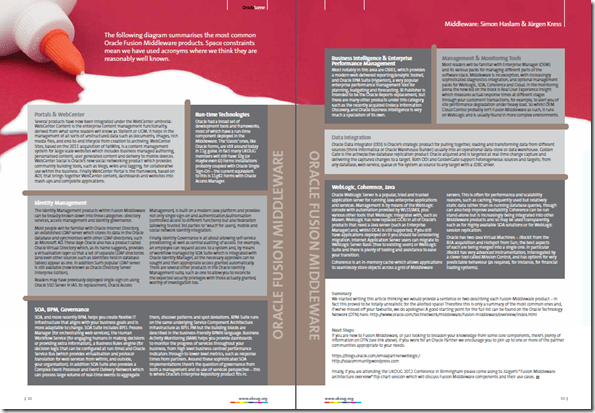
Simon Haslam, Principal Consultant, Veriton & myself published an middleware article in the UKOUG Scene magazine.  This article arose because Jürgen Kress’ “Fusion Middleware Architecture Overview
abstract was one of the most highly rated submissions for UKOUG 2012, so it seemed there
might be an interest in trying to clarify the products that Oracle calls ‘Fusion Middleware.’
Little did we realise how many products there were…

Fusion Middleware – what is it?

‘Middleware,’ as its name suggests, is a generic term for the layers of software (or ‘software glue’ – see http://www.middleware.org/whatis.html) that sit between an application and, within enterprise software, typically services and resources like the Oracle Database. Oracle Fusion Middleware started off as the Java EE application server (Internet Application Server) but evolved to cover pretty much all software that isn’t the database or applications!

Why is Fusion Middleware important?

Middleware provides infrastructure services to enable applications to run. For example, if you want a ‘container’ (i.e. a server with very specific APIs) to run your enterprise Java application, and most likely connect to a relational database, you use WebLogic Server; if your application wants to use web services somewhere out in the ether it calls the Oracle Service Bus. As you can tell these Middleware services are vital to the successful and continuing operation of your application. For a long

time Middleware has been seen as the poor relation to the database (which holds the irreplaceable business data) but this is changing as Middleware is now providing integration of, and decoupling from, the underlying resources, plus there is an increased demand for 24/7 (or close) availability of applications for use by customers, partners.. read the full article here and get your Scene magazine copy as a UKOUG member .

image

SOA & BPM Partner Community

For regular information on Oracle SOA Suite become a member in the SOA & BPM Partner Community for registration please visit  www.oracle.com/goto/emea/soa (OPN account required) If you need support with your account please contact the Oracle Partner Business Center.

Blog Twitter LinkedIn Mix Forum

BPM 11g – Dynamic Task Assignment with Multi-level Organization Units By Mark Foster

I have seen several requirements to have a more granular level of task assignment in BPM 11g based on some value in the data passed to the process. Parametric Roles is normally the first port of call to try to satisfy this requirement, but in this blog we will show how a lot of use-cases can be satisfied by the easier to implement and flexible Organization Unit.

The Use-Case

Task assignment is to an approval group containing several users. At runtime, a location value in the input data determines which of the particular users the task is ultimately assigned to.

In this case we use the Demo Community referenced in the SOA Admin Guide, and specifically the "LoanAnalyticGroup" which contains three users; "szweig", "mmitch" & "fkafka". In our scenario we would like to assign a task to "szweig" if the input data specifies that the location is "JapanCentral", to "fkafka" if the location is "JapanNorth" and to "mmitch" if "JapanSouth", and to all of them if the location is "Japan" i.e.


Read the full article

SOA & BPM Partner Community

For regular information on Oracle SOA Suite become a member in the SOA & BPM Partner Community for registration please visit  www.oracle.com/goto/emea/soa (OPN account required) If you need support with your account please contact the Oracle Partner Business Center.

Blog Twitter LinkedIn Mix Forum

ACM – Adaptive Case Management by Peter Paul

Adaptive case management (ACM) is also known as “dynamic case management”, is getting a lot of interest lately. BPM vendors identified this need while engaging with companies to manage existing business processes. And so ACM tools are emerging as complements to BPM. They provide a human-centric combination of process, content and collaboration to support knowledge workers to be more productive.

What is case management?


Case management is a way of organizing the work and activities in a company around a case instead of around a process or data. A Case is the coordination of multiple tasks – planned or unplanned – and associated content, towards a concrete objective or goal. Case oriented systems allow more flexibility and adaptability compared to process oriented solutions. Case oriented systems are better equipped to handle unstructured or less structured data compared to data oriented solutions.

Why would you need case management?

You would typically need ACM in a situation where you want activities to be managed, activities don’t have a fixed pre-determined sequence (there are unplanned parts), activities need access to content (both structured and unstructured data), and humans determine what need to happen while executing a process and/or need to interact with other experts (collaboration to solve the case).
Read the full article

SOA & BPM Partner Community

For regular information on Oracle SOA Suite become a member in the SOA & BPM Partner Community for registration please visit  www.oracle.com/goto/emea/soa (OPN account required) If you need support with your account please contact the Oracle Partner Business Center.

Blog Twitter LinkedIn Mix Forum

Build Mobile App for E-Business Suite Using SOA Suite and ADF Mobile By Michelle Kimihira

With the upcoming release of Oracle ADF Mobile, I caught up with Srikant Subramaniam, Senior Principal Product Manager, Oracle Fusion Middleware post OpenWorld to learn about the cool hands-on lab at OpenWorld. For those of you who missed it, you will want to keep reading.

Author: Srikant Subramaniam, Senior Principal Product Manager,Oracle Fusion Middleware.

Oracle ADF Mobile enables rapid and declarative development of native on-device mobile applications. These native applications provide a richer experience for smart devices users running Apple iOS or other mobile platforms. Oracle ADF Mobile protects Oracle customers from technology shifts by adopting a metadata-based development framework that enables developer to develop one app (using Oracle JDeveloper), and deploy to multiple device platforms (starting with iOS and Android).

Oracle ADF Mobile also enables IT organizations to leverage existing expertise in web-based and Java development by adopting a hybrid application architecture that brings together HTML5, Java, and device native container:

  • HTML5 allows developer to deliver device-native user experiences while maintaining portability across different platforms
  • Java allows developers to create modules to support business logic and data services
  • Native container provides integration into device services such as camera, contacts, etc

All these technologies are packaged into a development framework that supports declarative application development through Oracle JDeveloper. ADF Mobile also provides out of box integratoin with key Fusion Middleware components, such as SOA Suite and Business Process Management (BPM).

Oracle Fusion Middleware provides the necessary infrastructure to extend business processes and services to the mobile device — enabling the mobile user to participate in human tasks – without the additional “mobile middleware” layer. When coupled with Oracle SOA Suite, this combination can execute business transactions on Oracle E-Business Suite (or any Oracle Application).
Read the full article.

SOA & BPM Partner Community

For regular information on Oracle SOA Suite become a member in the SOA & BPM Partner Community for registration please visit  www.oracle.com/goto/emea/soa (OPN account required) If you need support with your account please contact the Oracle Partner Business Center.
Blog Twitter LinkedIn Mix Forum

Expanding the Oracle Enterprise Repository with functional documentation by Marc Kuijpers

Introduction
Have you ever experienced the challenge to map both your functional and technical assets in one software package? Finding a software package that is able to describe the metadata about these assets and their mutual relationships? And if you found the correct software package, was it maintainable?

The Oracle Enterprise Repository (OER) is a powerful SOA repository. Its core task is to map and visualize the interaction between technical assets generated by the SOA Suite and OSB. However, OER can be configured to not only contain these technical assets, but also to contain functional assets, i.e.: functional designs, use cases and a logical data model. Now that’s interesting! OER is able to show all the assets in your system and, if necessary, zoom in on one of the assets and their mutual relationships (Figure 1). This opens a set of doors to powerful features, e.g.:

  • Impact analsysis
    If a functional design is adjusted, which other functional designs and use cases do I need to adjust?
  • Traceability
    If a web service generates an error, in which functional and technical designs is the web service described

oer2 Expanding the Oracle Enterprise Repository with functional documentation

This sounds great, but how do we get all the functional and technical documents in OER, and how are we going to keep this repository up-to-date?
Read the full article.

SOA & BPM Partner Community

For regular information on Oracle SOA Suite become a member in the SOA & BPM Partner Community for registration please visit  www.oracle.com/goto/emea/soa (OPN account required) If you need support with your account please contact the Oracle Partner Business Center.

Blog Twitter LinkedIn Mix Forum

Announcing Upcoming SOA and JMS Introductory Blog Posts

Beginning next week, SOA Proactive Support will begin posting a series of introductory blogs here on working with JMS in a SOA context. The posts will begin with how to set up JMS in WebLogic server, lead you through reading and writing to a JMS queue from the WLS Java samples, continue with how to access it from a SOA composite and, finally, describe how to set up and access AQ JMS (Advanced Queuing JMS) from a SOA/BPEL process.

The posts will be of a tutorial nature and include step-by-step examples. Your questions and feedback are encouraged.

The following topics are planned:

  • How to Create a Simple JMS Queue in Weblogic Server 11g
  • Using the QueueSend.java Sample Program to Send a Message to a JMS Queue
  • Using the QueueReceive.java Sample Program to Read a Message from a JMS Queue
  • How to Create an 11g BPEL Process Which Writes a Message Based on an XML Schema to a JMS Queue
  • How to Create an 11g BPEL Process Which Reads a Message Based on an XML Schema from a JMS Queue
  • How to Set Up an AQ JMS (Advanced Queueing JMS) for SOA Purposes
  • How to Write to an AQ JMS Queue from a BPEL Process
  • How to Read from an AQ JMS Queue from a BPEL Process

Read the full article

SOA & BPM Partner Community

For regular information on Oracle SOA Suite become a member in the SOA & BPM Partner Community for registration please visit  www.oracle.com/goto/emea/soa (OPN account required) If you need support with your account please contact the Oracle Partner Business Center.

Blog Twitter LinkedIn Mix Forum

Installing Oracle Event Processing 11g by Antoney Reynolds

Earlier this month I was involved in organizing the Monument Family History Day. It was certainly a complex event, with dozens of presenters, guides and 100s of visitors. So with that experience of a complex event under my belt I decided to refresh my acquaintance with Oracle Event Processing (CEP).
CEP has a developer side based on Eclipse and a runtime environment.

Server install

The server install is very straightforward (documentation). It is recommended to use the JRockit JDK with CEP so the steps to set up a working CEP server environment are:image

  • Download required software
    • JRockit – I used Oracle “JRockit 6 – R28.2.5” which includes “JRockit Mission Control 4.1” and “JRockit Real Time 4.1”.
    • Oracle Event Processor – I used “Complex Event Processing Release 11gR1 (11.1.1.6.0)”
  • Install JRockit
    • Run the JRockit installer, the download is an executable binary that just needs to be marked as executable.
  • Install CEP
    • Unzip the downloaded file
    • Run the CEP installer, the unzipped file is an executable binary that may need to be marked as executable.
    • Choose a custom install and add the examples if needed.
      • It is not recommended to add the examples to a production environment but they can be helpful in development.

Developer Install

The developer install requires several steps (documentation). A developer install needs access to the software for the server install, although JRockit isn’t necessary for development use.
Read the full article by Antony Reynolds.

SOA & BPM Partner Community

For regular information on Oracle SOA Suite become a member in the SOA & BPM Partner Community for registration please visit  www.oracle.com/goto/emea/soa (OPN account required) If you need support with your account please contact the Oracle Partner Business Center.

Blog Twitter LinkedIn Mix Forum

Real User Experience Insight: Oracle’s Approach to User Experience

This self-study course is the first in a series about Oracle Real User Experience Insight. Intended for a broad, general audience, this course begins with a discussion on why user experience is important, followed by Oracle’s approach to user experience. Next, several use cases for Real User Experience Insight is presented. The course ends by showing how Real User Experience Insight is integrated with Oracle Enterprise Manager 12c. This course is a suggested prerequisite for the other two self-studies in this series, one that focuses on basic navigation, data structures and workflows, and the other that focuses on best practices in deployment.

SOA & BPM Partner Community

For regular information on Oracle SOA Suite become a member in the SOA & BPM Partner Community for registration please visit  www.oracle.com/goto/emea/soa (OPN account required) If you need support with your account please contact the Oracle Partner Business Center.

Blog Twitter LinkedIn Mix Forum

Fault Handling Slides and Q&A by Vennester

Fault Handling
It is one thing to architect, design, and code the “happy flow” of your automated business processes and services. It is another thing to deal with situations you do not want or expect to occur in your processes and services. This session dives into fault handling in Oracle Service Bus 11g and Oracle SOA Suite 11g, based on an order-to-cash business process. Faults can be divided into business faults, technical faults, programming errors, and faulty user input. Each type of fault needs a different approach to prevent them from occurring or to deal with them. For example, apply User Experience (UX) techniques to improve the quality of your application so that faulty user input can be prevented as much as possible. This session shows and demos what patterns and techniques can be used in Oracle Service Bus and Oracle SOA Suite to prevent and handle technical faults as well as business faults.

Q&A
This section lists answers to the questions that were raised during the preview event.
Q: Where can retries be configured in Oracle Service Bus?
The retry mechanism is used to prevent faults caused by temporary glitches such as short network interruptions. A faulted message is resend (retried) and might succeed this time since the glitch has passed. Retries are an out-of-the-box feature that can be used in Oracle Service Bus and Oracle SOA Suite using the Fault Policy framework. By default, retries are disabled in Oracle Service Bus. Read the full article.

SOA & BPM Partner Community

For regular information on Oracle SOA Suite become a member in the SOA & BPM Partner Community for registration please visit  www.oracle.com/goto/emea/soa (OPN account required) If you need support with your account please contact the Oracle Partner Business Center.

Blog Twitter LinkedIn Mix Forum