Store, connect & govern your enterprise data for your AI Agents – Oracle 23AI book by Asim Chowdhury
February 5, 2026 Leave a comment
Oracle 23AI ADBS in Action is a definitive guide to the AI-native database, demonstrating how enterprise data can be transformed into an intelligent, conversational automation fabric. The book shows how Oracle 23AI elevates the data layer into a smart foundation for AI-driven business processes. Building on this core, Oracle Integration seamlessly connects Oracle 23AI with AI agents and automation workflows, enabling secure, event-driven orchestration while maintaining human oversight through approvals, policy enforcement, and auditable decision paths. Through hands-on QuickMart case studies, advanced capabilities—including vector search, JSON duality views, autonomous optimizations, and in-database machine learning—are translated into practical, real-world implementations. The result is an end-to-end, actionable blueprint for DBAs, developers, and data scientists to build high-performance, compliant, and truly intelligent data platforms on Oracle 23AI.
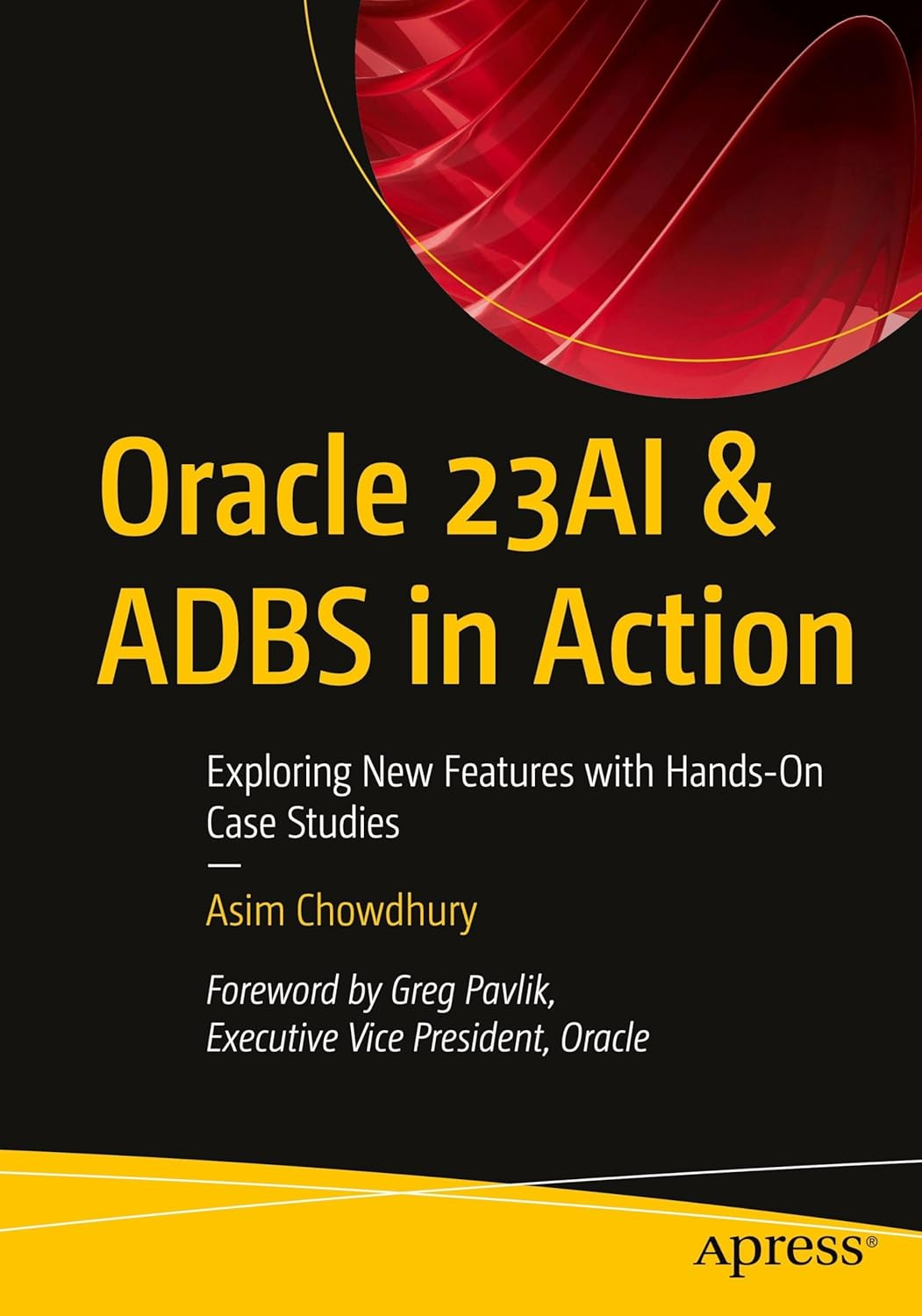
Oracle 23AI & ADBS in Action: Exploring New Features with Hands-On Case Studies
Unlock the power of Oracle Database 23AI and Autonomous Database Serverless (ADB-S) with this comprehensive guide to the latest innovations in performance, security, automation, and AI-driven optimization. As enterprises embrace intelligent and autonomous data platforms, understanding these capabilities is essential for data architects, developers, and DBAs.
Explore cutting-edge features such as vector data types and AI-powered vector search, revolutionizing data retrieval in modern AI applications. Learn how schema privileges and the DB_DEVELOPER_ROLE simplify access control in multi-tenant environments. Dive into advanced auditing, SQL Firewall, and data integrity constraints to strengthen security and compliance.
Discover AI-driven advancements like machine learning-based query execution, customer retention prediction, and AI-powered query tuning. Additional chapters cover innovations in JSON, XML, JSON-Relational Duality Views, new indexing techniques, SQL property graphs, materialized views, partitioning, lock-free transactions, JavaScript stored procedures, blockchain tables, and automated bigfile tablespace shrinking.
What sets this book apart is its practical focus—each chapter includes real-world case studies and executable scripts, enabling professionals to implement these features effectively in enterprise environments. Whether you’re optimizing performance or aligning IT with business goals, this guide is your key to building scalable, secure, and AI-powered solutions with Oracle 23AI and ADB-S.
What You Will Learn
- Explore Oracle 23AI’s latest features through real-world use cases
- Implement AI/ML-driven optimizations for smarter, autonomous database performance
- Gain hands-on experience with executable scripts and practical coding examples
- Strengthen security and compliance using advanced auditing, SQL Firewall, and blockchain tables
- Master high-performance techniques for query tuning, in-memory processing, and scalability
- Revolutionize data access with AI-powered vector search in modern AI workloads
- Simplify user access in multi-tenant environments using schema privileges and DB_DEVELOPER_ROLE
- Model and query complex data using JSON-Relational Duality Views and SQL property graphs
Who this Book is For
Database architects, data engineers, Oracle developers, and IT professionals seeking to leverage Oracle 23AI’s latest features for real-world applications
Get the book here. For additional integration books please visit the wiki here.


![image[7][2][2][2]](https://paascommunity.com/wp-content/uploads/2013/04/image7222.png?w=20&h=20&h=20 "image[7][2][2][2]")
![clip_image002[8][4][2][2][2]](https://paascommunity.com/wp-content/uploads/2013/04/clip_image00284222.jpg?w=26&h=23&h=23 "clip_image002[8][4][2][2][2]")


 PaaS Community Blog