Oracle OpenWorld 2018 Call for Papers – open until March 22nd 2018

image

Welcome to the Call for Speakers Submission Page for Oracle OpenWorld 2018

IMPORTANT NOTE ABOUT SUBMITTING: The submission tool will time out after 15 minutes of inactivity based on the oldest inactive tool window and you will lose the submission you were working on.

Please review the Speaker Guidelines and Instructions for submission information and key dates (subject to change) for Oracle OpenWorld before starting your proposal.

Make sure to take note of your session confirmation number after you enter the session.

By submitting a proposal for consideration, you authorize Oracle to promote, publish, display, and disseminate the content submitted to Oracle, including your name and likeness, for use associated with Oracle OpenWorld 2018. Press, analysts, bloggers and social media users may be in attendance at Oracle OpenWorld.

RainFocus supports Internet Explorer 11 and Edge, as well as the current versions of Firefox, Chrome and Safari.

Key Dates

OpenWorld Call for Speakers — Open February 27

OpenWorld Call for Speakers — Closed March 22, Midnight PST

Notifications for accepted and declined submissions sent Mid-May

Please submit your paper here and  see additional Call for Papers here

Oracle Process Cloud Service – Decision Model Notation part 2 by Lykle Thijssen

image

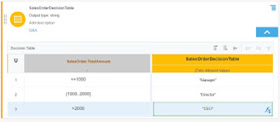
In my previous blog, I showed how to get started with Decision Model Notation (DMN) in Oracle Process Cloud Service and how to create a simple Decision Table. Picking up from there, we will now look into creating If-Then-Else rules, which should also be familiar to people who know Oracle’s old Business Rules. We will also create a service and call it from a process.

Creating an If Then Else Decision

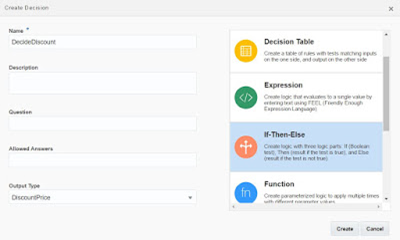
As Input, I have created a TotalAmount object, which is the total amount of a Sales Order. Based on this TotalAmount, we are going to calculate a Discount Price, for which I have created a DiscountPrice type to make the service interface a bit prettier than just ‘output’. To create an If-Then-Else rule, just click the + button next to Decisions, enter a name and set the output type to string, number or any other type, in this case DiscountPrice.

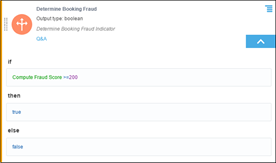
Now, Oracle will have created a rule for you, in which you only need to fill in the "if", "then" and "else". Since you’ve already decided your output object, we will not use that one in the expression, which is different from the old Oracle Business Rules. So just enter the value that you want for this object and you’ll be fine. You can also create nested expressions, as shown below: Read the complete article here.

Oracle Process Cloud Service – Decision Model Notation part 1 by Lykle Thijssen

image

Recently, Oracle Process Cloud Service (PCS) has made another major step forward through the addition of a whole new way of dealing with business rules. This brand new Decision Model Notation (DMN) feature is developed seperate from the actual processes and deployed as a microservice, so your decision models can be reused and everything is nicely loosely coupled. I like it.
What I also like about DMN is that it’s much more (business) user friendly than the rule engine from Oracle SOA Suite, which was used until now. While it was performing well and somewhat agreeable for technical users, business users were often lost and leaving the business rule modelling to developers. With this new DMN feature, this is no longer necessary. Business users will be able to do much more, if not everything, themselves and actually enjoy the experience!
I’ve decided to write a series of blogs about the different types of decision models that can be created and how to use them. But first we need to turn it on.

Getting Started

When you’re in the home screen, click on your login name in the top-right corner and choose ‘Administration’. On the Admin page, go to ‘UI Customization’ and tick ‘Enable DMN in Composer’, then Save. Read the complete article here.

Uncovering Booking Fraud with Oracle Process Cloud Service (PCS) and Decision Model Notation (DMN) by Arun Pareek

image

In a previous blog post, I wrote about the new Decision Modeling capability introduced in Oracle Process Cloud Service. The earlier post provided an introduction to DMN and a usage scenario along with a working prototype.

The decision modeling and notation standard released by OMG is a very powerful framework providing an implementation and modeling specification for solving many complex operational and strategic decision in an organization. In this second blog post of the series, I will put the DMN engine in Oracle PCS through a litmus test by implementing a complex decision modeling use case.

To make matters more interesting, I have now selected a decision modelling scenario published as an open challenge in the Decision Management Community in February. The solution shared in this post has been accepted and validated by the community moderator.

The modeling approach shared in this blog is based on the principle of “Inherent Simplicity” which says that every situation, no matter how complex it initially looks, is exceedingly simple. I chose this use case as it shows how principles of decision modeling can allow us to break a layered problem into simpler and easy to implement fragments. Read the complete article here.

Streamline your Oracle PCS Process Models with Decision Model Notation by Arun Pareek

image 

Introduction to DMN and Feature Preview

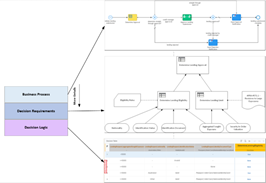
With the latest release of the Process Cloud Service (17.1.3), Oracle has released a preview version of its much awaited Decision Model and Notation (DMN) engine. The DMN standard provides a powerful meta-model, notation and semantics for modeling of operational decision and business rules. It is a critical addition in the process, case and decision modeling framework providing an open standard for modeling the data and logic associated within a process.

The notation standard aims at defining requirements and decision logic for manual and automated decision-making by representing a complete, executable model which can either be used independently or in conjunction with a business process. Similar to BPMN, it aims to support designing of decision models, providing guided operational decision and potentially automation of operational decisions. A combination of process and decision modeling simplifies business processes by eliminating and replacing sections of a process model with a decision model. The decision logic of the process model is captured as a separate, yet linked, model. By focusing on decisions and processes independently the requirements process is more focused. A decision-driven process acts on the outcome of the evaluation of decision logic in several possible ways, including: Read the complete article here.

bpmNEXT: Boost Business Process Agility with DMN, by Eduardo Chiocconi


image

Watch the video here.

Wellness First: an inside look at Beacon technology by Alessia Sacchi

image

“Just like lighthouses have helped sailors navigate the world for thousands of years, electronic beacons can be used to provide precise location and contextual cues within apps to help you navigate the world.” (The Google Beacons development team)

What I find thrilling about beacons is that in their simplest sense they are unaware of themselves or any devices around them and we – humans – are not aware of them. So how is possible that these tiny transmitters are being used to help people in their daily lives? According to reports, 5 million beacons attached to the walls around the world are used to offer great help to people with regard to an array of things like travel, shopping, parking, entertainment, transportation, inventory management, assets tracking, indoor navigation  and at last but not least in the healthcare space through more efficient processes and improved patient-care.

Wellness First is a fictitious gym that utilizes beacons to improve the customer experience. In this post we’ll take a close look at the Ionic Framework Mobile App I’ve built that uses Estimote beacons to target a customer located near the room where a Yoga class  is just about to start and offers an unbeatable discount. Read the complete article here.

6 Reasons Why Companies Need IoT by: Kirk Carlsen


imageDuring my time as a professional cyclist, I learned that the more information and technology I could leverage, the faster I rode. As technology improved, the data and insights I collected from daily training optimized my performance. I monitored things like heart rate, power, and nutrition and incorporated all of it into my routine. The more I analyzed and integrated this data into my training regimen, the better I began to understand how sensitive each individual aspect of my lifestyle was and how information delivered key indications of my fitness. In a sport where races are won and lost sometimes by inches, any increase in my fitness, even if it was only one percent, could mean the difference between winning and losing. If I could have connected my entire body to sensors that delivered real-time insights to increase performance, I would have.

In athletics, I was just touching the surface of how to incorporate information technology into understanding human potential. Luckily for business, similar enterprise transformations are possible today by using key technologies such as the Internet of Things (IoT). With the visibility and analytics delivered by connected devices, companies can make the right decisions at the right time, safeguarding profitability and customer service. And not unlike cycling, small percentages in improvement for a business could mean the difference between establishing competitive advantage or dropping behind the pack. So, here are six key reasons why I think organizations across every industry need to adopt IoT into their digital transformation strategy.

1. Increase Visibility Across Siloed Business Functions to Improve Business Maturity. Read the complete article here.

Visual Builder Cloud Service – PaaS Partner Community Webcast – February 28th 2018

image

Attend our February edition of the PaaS Partner Community Webcast live on February 28th 2018 at 16:30 CET. In the webcast John Ceccarelli and Angelo Santagata will update you on the Visual Builder Cloud Service and how to extend SaaS.

John Ceccarelli LinkedInimage

Angelo Santagata LinkedIn & Twitter

Visit the registration page here.

Call ID: 5566478 Call Passcode: 249228

UK: +44 (0) 208 118 1001 & United States: 140 877 440 73 image

More Local Numbers

Mobile and JavaScript Rapid App Development with Visual Builder Cloud Service

The Oracle Cloud Tooling team is excited to preview the new version of Visual Builder Cloud Service. This version:

* Unites the MAX and ABCS products into a single design time and runtime for building JET-based mobile and web applications

* Expands our audience from business users to include Rapid Application developers and traditional code-first developers

* Provides enhanced flexibility to build any type of UI you can image

* Gives you full two-way code editing between the visual designer and code view

* Provides declarative support for connecting to any REST service

* Integrates seamlessly with Oracle SaaS, Process Cloud, Integration Cloud, and any on-premise app supported by an Integration Cloud connector

Schedule:

Tuesday February 28th 2018 16:30 – 17:30 CET

Visit the registration page here.

Missed our PaaS Partner Community Webcast? – watch the on-demand versions:

· Container Native Application Development Platform January 23rd 2018

· Oracle free Cloud Demo Services December 15th 2017

· Oracle Integration Cloud (OIC) November 21st 2017

· Adaptive Case Management in PCS October 31st 2017

· Oracle OpenWorld 2017 September 25th 2017

· Cloud Compliance & Certification August 2017

· Wercker July 21st 2017

· Sales Play webcast June 28th 2017

· Process Cloud Service update – DMN capabilities May 23rd 2017

· Drive DevOps Agility and Operational Efficiency with Oracle Management Cloud April 25th 2017

· Implementing DevOps and Agile Methodologies in Oracle Projects March 21st 2017

· Mobile Cloud Service & Chat Bots February 28th 2017

· b2b January 31st 2017

· Community Resources & free Cloud trails December 20th 2016

· SOA 12 & BPM Suite 12c Roadmap update November 29th 2016

· Microservices October 25th 2016

· Oracle OpenWorld 2016 update September 27th 2016

· API Cloud Platform Service August 30th 2016

· BPM Suite & PCS Update July 26th 2016

· Integration Cloud Service June 28th 2016

· Sales Plays Webcast June 9th 2016

· Real-Time Integration Business Insight May 31st 2016

For the latest information please visit Community Updates Wiki page (SOA Community membership required).

SOA & BPM Partner Community

For regular information on Oracle SOA Suite become a member in the SOA & BPM Partner Community for registration please visit www.oracle.com/goto/emea/soa (OPN account required) If you need support with your account please contact the Oracle Partner Business Center.

Blog Twitter LinkedIn image[7][2][2][2] Facebook clip_image002[8][4][2][2][2] Wiki

Technorati Tags: SOA Community,Oracle SOA,Oracle BPM,OPN,Jürgen Kress,webcast

PaaS (Process & Integration) Partner Community Newsletter February 2018

Dear PaaS Partner Community

With more than 250 registration, the PaaS Partner Community Forum 2018 is almost booked out take the opportunity to become an expert in the latest PaaS services including machine learning, blockchain, IoT and Microservices. Looking forward to welcome you in Budapest!

In case you can’t attend the conference we offer in February and April free on-demand bootcamps for SOA Suite 12c and BPM Suite 12c. For details and registration please see the community training calendar (membership required).

With the raise of 3rd generation API Management the Oracle API Platform Cloud Service is a leader. Start with Apiary for a design first approach. Use API Platform Cloud Service to manage, connect and secure APIs. With the policies and gateway you can validate your deployments. Great opportunity for partners to start the digital transformation of your customers and generate service revenue. For more information get the API partner resource kit here.

Thanks to the community for sharing all the Integration articles: Teaching How to Recover Errored Instances with Oracle Integration Cloud & REST API for Oracle SOA Cloud Service & Recipe in Oracle Self-Service Integration & FMW Oracle Service Bus (OSB) Domain Monitoring Solution and Features & Which SOA Product Support Ends in 2018 & Purging of SOA Composite Revisions with FlexDeploy & Streamline Development in Oracle Projects.

Oracle and UiPath join forced to accelerate Robotic Process Automation (RPA). Watch a short RPA video here and visit the UiPath session and information point during our PaaS Partner Community Forum. This month pizza becomes a dynamic process, Richard, Marcel and Marc served the next round of Jarvis pizza Jarvis Pizzeria in Case Management Style & Getting Started with Dynamic Processes (ACM) & Setting up the Dynamic Process & Third step in Implementing the Order Processing, Correlation.

In our last innovation and architecture section it is all about blockchain. A great starting point is the NIST blockchain report for business beginners. Every developer should be aware of blockchain specially for industrial use.

For a short summery of our key monthly information watch the Fusion Middleware & PaaS Partner Updates on YouTube. The February edition highlights the PaaS Partner Resource Kits for chabots, API CS, OIC and to Integrate SaaS. This month’s community webcast will introduce Visual Builder Cloud Service, please join our monthly PaaS Partner Community Webcast – February 28th 2018. A great use case for Visual Builder Cloud Service is to extend HCM.

Want to publish your best practice article & news in the next community newsletter? Please feel free to send it via Twitter @soaCommunity #PaaSCommunity!

To read the newsletter please visit http://tinyurl.com/PaaSNewsFebruary2018 (OPN Account required)

Please like and share the newsletter at Twitter and LinkedIn.

Jürgen Kress

Fusion Middleware Partner Adoption
Oracle EMEA
Tel. +49 89 1430 1479
E-Mail: juergen.kress@oracle.com
clip_image003Blog clip_image004LinkedIn clip_image005 Twitter

To become a member of the SOA Partner Community please register at http://www.oracle.com/goto/emea/soa (OPN account required) If you need support with your account please contact the Oracle Partner Business Center.

Newsletter Logo 2017

Blog Twitter LinkedIn image[7][2][2][2] Facebook

Technorati Tags: newsletter,SOA Community newsletter,SOA Community,Oracle,OPN,Jürgen Kress