With the launch of the Oracle Cloud PaaS Platforms we will make the SOA & BPM Partner Community cloud ready. In this article series we will lay the foundation for cloud computing including definition and concepts.
 Content
Cloud Computing Hype Introduction
Cloud Computing Definition and Criteria
Concepts in Cloud Computing
Industry focus & use case Cloud Computing Providers & Consumers
Differences between Cloud Definitions
NIST Cloud Computing Reference Architecture
Cloud Broker
Types Cloud Broker
Challenges Cloud Broker
Cloud Computing Hype Introduction
 Why is everyone talking about cloud computing? Drawn-out, expensive IT projects that are planned and implemented with few benefits for the business stakeholders are commonplace. In contrast, cloud computing offers business users the chance to immediately implement services with usage-based billing that are tailored to their requirements, often without the need to consult with the IT department.
However, aspects including security, architecture, availability, and standards are often not evaluated. Cloud consumers find themselves at the mercy of the cloud provider. Scenarios that require changing cloud providers after a cloud provider goes bankrupt, and the associated moving of data and/or applications, have not yet been sufficiently tested. Business continuity should play a key role from the start of a cloud evaluation process.
One of the greatest challenges here is the integration of existing data and systems into the cloud solution. Without integration spanning clouds and on premise systems, processes can only be executed in isolation, leading to cloud-specific silos of isolated solutions. Important information for users is not available across processes and systems. Problems that would have occurred in the company’s internal IT are now shifted to the cloud provider. To prevent "legacy clouds" or solutions that are hard to maintain, it is important to manage the entire architecture proactively and, in particular, the integration into the cloud. Even if cloud providers want us to believe otherwise, not every aspect of IT can be outsourced to cloud solutions!
Cloud Computing Definition and Criteria
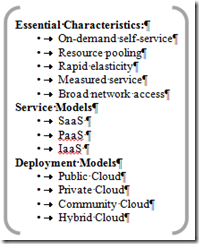
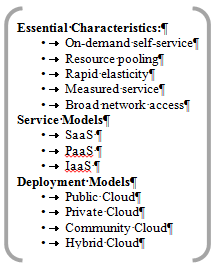
Cloud computing is a model for usage-based network access to a common pool of configurable computing resources (e.g. networks, servers, storage systems, applications, and services) that can be provided and used quickly. IP-based services are requested via self-service and used online independently. A prerequisite for this is a broadband Internet connection with low latency. The IT resources are bundled into pools and provided as required. Billing is based on the services used. *1
Concepts in Cloud Computing
In cloud computing, the following models are differentiated on the basis of horizontal scaling:
· Infrastructure-as-a-Service (IaaS) – provides a hardware platform as a service, such as Amazon EC2 or Oracle Compute Service (now in preview)
· Platform-as-a-Service (PaaS) – provides a software platform as a service, such as Google Apps Engine or Oracle Java Cloud
· Software-as-a-Service (SaaS) – allows applications and functions to be outsourced by virtualizing cloud providers’ hardware and software and providing the functions as services, such as Salesforce CRM [REF-1] or Oracle Sales Cloud
In deployment models, distinctions are made according to availability and installation location. Public clouds are services that are available to the public on the Internet. Private clouds are internal company services. Hybrid clouds and community clouds represent mixtures of these models, such as when Amazon computing power is used in the event of a failure or overload of an internal company cloud application.
Industry focus & use case Cloud Computing Providers & Consumers
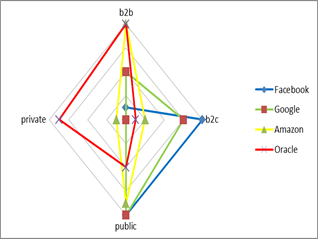
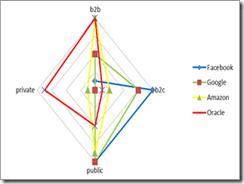 Large companies for which IT plays a central role or represents a competitive advantage often build internal company cloud solutions in their own data centers “private clouds”. Small and medium enterprises frequently use public cloud services. A further distinguishing feature is the cloud consumer focus. In the business-to-business segment, private clouds are predominantly used, while in the business-to-consumer segment the majority are public clouds (Figure: 1).
Differences between Cloud Definitions
Thomas Erl, Ricardo Puttini and Zaigham Mahmood define cloud computing in his latest book “Cloud Computing Concepts, Technology & Architecture”. Based on the NIST cloud computing definition they add “ubiquitous access” as a cloud characteristic, to reflect the trend that more and more services are used on mobile devices. As cloud computing becomes more and more adopted also in b2b services, companies run mission critical applications on a global level in the cloud, resiliency of this services becomes important. Therefore Thomas Erl Ricardo Puttini and Zaigham Mahmood add also “resiliency” to the cloud characteristics.*2
Wikipedia defined cloud computing more from a consumer perspective. The article highlights that cloud computing is often used as a jargon term without a commonly accepted non-ambiguous scientific or technical definition.*3. From my perspective the NIST definition is widely accepted between b2b vendors. Many software vendors try to brand their solutions as cloud solution, or cloud enabled solutions without to respect the NIST cloud definition. This reflects the change of the IT industry caused by cloud computing.
NIST Cloud Computing Reference Architecture
Together with the “The NIST Cloud Definition of Cloud Computing” the “NIST Cloud Computing Reference Architecture” lays the theoretical foundation of cloud computing. The NIST Cloud Computing Reference Architecture extends the definition by a reference architecture and a taxonomy. An additional actor and role model is introduced. The cloud provider offers IaaS, PaaS or SaaS services to the cloud consumer. Between them a cloud broker might offer service intermediation, service aggregation and service arbitrage. These services become more important as cloud services need to be integrated with on premise and integrated or exchanged between different cloud providers. A cloud carrier transports the cloud services from the cloud provider to the cloud consumer. A cloud auditor might support the cloud consumer and cloud provider in security, privacy impact and performance audits*4
Cloud Broker
NIST and Gartner define three different types of cloud brokers:
Service Intermediation
Provides value added services on top of a cloud platform. An example is the Force identity service from Salesforce. This identity service can be used to identify users across several cloud services.
Service Aggregation
Ensures the interoperability between different cloud services. An example is Boomi from Dell. The service let cloud consumers integrate for example a Salesforce CRM system with a Netleger billing system and or an on premise solution. As IT System are often historical grown and rally build on a green field approach cloud aggregation becomes key for cloud adoption.
Service Arbitration
A cloud service arbitrage provides flexibility and an “opportunistic choices” by offering multiple similar services to select from.*5 Heroku for example lets the cloud consumer choose between different cloud services. The cloud consumer might increase service level agreements or reduce the dependency from one cloud provider by a service arbitration service.
Key Benefits of Cloud Brokers
Key benefits of cloud brokers might include:
• Cloud interoperability: Integration between several cloud offerings
• Cloud portability: Move application between different cloud vendors
• Different data models between cloud offerings
• Modular services between several cloud offerings e.g. security, document or notification services to increase developer productivity and user usability & security
• Increase business continuity by reducing dependency from one cloud provider
• Increase SLAs by leverage multiple cloud provider
Challenges Cloud Brokers
Large leading cloud providers e.g. Google or Salesforce try to offer comprehensive services & platforms for cloud consumers. Often they are not interested to enable cloud broker services which might enable cloud consumer to choose or broker between different cloud providers. Sometimes their strategy can be characterized as a vendor log-in. Today no industry wide standard for cloud brokers is developed. To enable seamless service aggregation on a process level, between different cloud providers a meta-data model between them needs to be established. This model needs to include joint business objects and services to ensure seamless processes across multiple cloud providers.
Cloud consumers Dependencies based on Service Layer
The risk of such a vendor login might be based on the service model the cloud consumer chooses. The higher the service model, less has to build by the cloud consumer, more is provided by the cloud provider, the higher the risk of vendor login:
|
Service Model
|
Risk vendor login
|
Advice
|
|
SaaS
|
High
|
Same application on-premise available
|
|
PaaS
|
Medium
|
Standard programming language available several clouds
|
|
IaaS
|
Low
|
Operating & Virtualization technologies
|
With the need of cloud Brokers versus the trend to build whole cloud Economies by one dominant player this might be one of the most challenging and exciting areas of cloud computing in the next years. Today cloud consumers might carefully evaluate this in the cloud selection phase to ensure business continuity.*6
References
- NIST Definition Cloud Computing
- „Cloud Computing Concepts, Technology & Architecture” Thomas Erl, Zaigham Mahmood, Ricardo Puttini, PRENTICE HALL June 2013
- Wikipedia http://en.wikipedia.org/wiki/Cloud_computing
- NIST Cloud Computing Reference Architecture
- Gartner
- NIST Definition Cloud Computing
For more information on Cloud Integration please visit www.soacommunity.com
SOA & BPM Partner Community
For regular information on Oracle SOA Suite become a member in the SOA & BPM Partner Community for registration please visit www.oracle.com/goto/emea/soa (OPN account required) If you need support with your account please contact the Oracle Partner Business Center.
 Blog
Blog  Twitter
  LinkedIn
 ![image[7][2][2][2]](https://paascommunity.com/wp-content/uploads/2013/04/image7222.png?w=20&h=20 "image[7][2][2][2]") Facebook
Facebook ![clip_image002[8][4][2][2][2]](https://paascommunity.com/wp-content/uploads/2013/04/clip_image00284222.jpg?w=26&h=23 "clip_image002[8][4][2][2][2]") Wiki
Wiki
SOA Community,Oracle SOA,Oracle BPM,OPN,Jürgen Kress. Cloud, cloud service broker, cloud integration
 Part 1 of the Oracle SOA 11g Performance Tuning Webinar Series. Delivered by Steve Millidge, C2B2 Technical Director, on the 21st of January 2013.





 PaaS Community Blog