SOA Suite 12.2.1.1.0 download available


imageThis new release includes bug fixes as well as new features including:

  • New Cloud Adapters for Oracle and 3rd-party applications
  • Operational Enhancements
  • BAM and Real-Time Integration Business Insight Enhancements
  • Major expansion of MFT functionality

For a list of new features in this release, please check the list of new features in SOA Suite and Managed File Transfer 12.2.1.1.0. Get SOA Suite 12.2.1.1 here

SOA & BPM Partner Community

For regular information on Oracle SOA Suite become a member in the SOA & BPM Partner Community for registration please visit www.oracle.com/goto/emea/soa (OPN account required) If you need support with your account please contact the Oracle Partner Business Center.

Blog Twitter LinkedIn image[7][2][2][2] Facebook clip_image002[8][4][2][2][2] Wiki

Middleware Summer Camps free virtual training SOA Suite 12c, BPM Suite 12c & WebLogic 12c: August & September 2016


VirtualSummerCamps2016small

You are working on large Fusion Middleware & PaaS opportunities & projects? Oracle is pleased to invite you to the  Middleware Summer Camps 2016. For technical experts we offer live virtual classes:

SOA Suite 12c Training On Demand

BPM Suite 12c Training On Demand

WebLogic 12c Training On Demand


SOA & BPM Partner Community

For regular information on Oracle SOA Suite become a member in the SOA & BPM Partner Community for registration please visit www.oracle.com/goto/emea/soa (OPN account required) If you need support with your account please contact the Oracle Partner Business Center.

Blog Twitter LinkedIn image[7][2][2][2] Facebook clip_image002[8][4][2][2][2] Wiki

Increase speed to deployment of SOA with FlexDeploy by Dan Reynebeau


clip_image002With SOA, you can have hundreds of composites that need to be setup for deployment and this can be a challenge.  With FlexDeploy, we have a way to mass load and create projects from a csv file. Through the use of a template (a groovy script along with inputs) in conjunction with the csv file, projects can be created within a few minutes.

So now that I have your interest.  Let’s get started with how this feature can assist you in getting to the deployment of SOA composites faster.

First, we need to make sure that several project components have been created in FlexDeploy prior to running the mass load, as the mass load will validate the data in the csv file against the data in FlexDeploy and warn you when there is a issue.  Components that need to be created prior are build/deploy workflows, build/deploy instances, SCM instance (SVN or GIT) and the SOA plugin needs to be uploaded.

Second, we need to have a template defined in FlexDeploy. Read the complete article here.

SOA & BPM Partner Community

For regular information on Oracle SOA Suite become a member in the SOA & BPM Partner Community for registration please visit www.oracle.com/goto/emea/soa (OPN account required) If you need support with your account please contact the Oracle Partner Business Center.

Blog Twitter LinkedIn image[7][2][2][2] Facebook clip_image002[8][4][2][2][2] Wiki

Custom Transports in Service Bus 12.2.1 by Ricardo Ferreira


clip_image002Oracle Service Bus (or Service Bus for short) provides a very powerful set of APIs that allow experienced Java developers to create custom transport providers. This is called Service Bus Transport SDK. By using this SDK, it is possible to create custom transport providers to handle both inbound and outbound message handling for specific protocols, without having to worry with the internal details of Service Bus.

The objective of this post is not about how the Service Bus Transport SDK works, neither about providing examples about how to use it. This is very detailed in the Service Bus documentation. Instead, we are going to cover the specifics about creating custom transport providers for Service Bus 12.2.1. Thus; this post will walk through the changes and challenges introduced by this new version, which may help people that want to port their custom transports from previous versions of Service Bus to 12.2.1.

Changes in the Classpath

No matter which IDE you commonly use to develop the code for custom transport providers, when you try to open your project you will face some annoying classpath issues. This will happen because the 12.2.1 version of Service Bus changed many of its JAR files, in an attempt to create a more consistent system library classpath. This is also true for some JAR files that belongs to WebLogic, and many others from the Fusion Middleware stack.

Therefore, you will have to adapt your classpath to be able to compile your source-code again, either compiling the code from the IDE or using the Ant javac task. The XML snippet below is an Eclipse user library export with some of the most important JARs that you might need while working with Service Bus 12.2.1. Read the complete article here.

SOA & BPM Partner Community

For regular information on Oracle SOA Suite become a member in the SOA & BPM Partner Community for registration please visit www.oracle.com/goto/emea/soa (OPN account required) If you need support with your account please contact the Oracle Partner Business Center.

Blog Twitter LinkedIn image[7][2][2][2] Facebook clip_image002[8][4][2][2][2] Wiki

Handling inbound Attachments by Service Bus by Apostolos Varsamis


clip_image002Introduction

Oracle Service Bus message context is a set of properties, so called context variables, that hold message content as well as information about messages as they are routed through Oracle Service Bus (OSB). The Message Context Schema specifies the element types for the predefined message context variables.

Such a predefined context variable is the variable attachments.

Fig. 1 shows in an excerpt of the Message Context Schema the definition of the element attachmens.

Obviously the attachment body can hold either a reference of the content or the content itself!

In this article we analyze what contains exactly the element /mc:attachments/mc:attachment/mc:body and how we can handle its contents.

First of all let us focus on the variables

  • Content-Types
  • Content-Transfer- Encoding

their meanings and their possible values.

Content-Type

According to the W3 specifications (s. [1]) Fig. 2 contains an excerpt of the main characteristics of the variable Content-Type: Read part 1 here and Read part 2 here

SOA & BPM Partner Community

For regular information on Oracle SOA Suite become a member in the SOA & BPM Partner Community for registration please visit www.oracle.com/goto/emea/soa (OPN account required) If you need support with your account please contact the Oracle Partner Business Center.

Blog Twitter LinkedIn image[7][2][2][2] Facebook clip_image002[8][4][2][2][2] Wiki

Error Resilient Adapters – SOA 12.2.1 Resiliency Feature by Kevin King


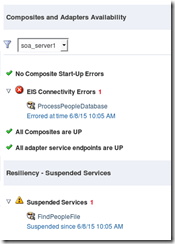
clip_image001New to SOA 12.2.1 is the concept of Resiliency.  Oracle has introduced functionality that shuts down adapters when their composite failure meets a certain threshold. In effect, an error circuit breaker!  This is extremely helpful to prevent filling up the error hospital with an abundance of errors.  When suspended, the failed composite will retry the composite at a defined interval in an attempt to un-suspend the service adapter.  The idea is to suspend any inbound adapters so that messages can be queued whenever an error is present and then processed later when the service is fixed.

Currently, resiliency currently only works for a small subset of adapters.  These adapters include EDN, File, FTP, AQ, and JMS. 

My Example – File Adapter

I deployed a sample project that used a file adapter to read a file and insert those records into a database table.  Once the global resiliency policy was configured for the server, there is no special setup or additional configuration needed at the process/project level. 

I dropped a few files into the staging area that the file adapter read, and off they went.  All the records were inserted into the database as expected.  To cause a failure, I renamed the database table.  Now, my database adapter will no longer be able to find the table it needs to insert into.  I copied a few more files into the staging directory and, as expected, they disappeared and faulted instances showed up.  However, because I had configured the global resiliency to trigger with three errors in two minutes the file adapter now shows as suspended. Read the complete article here.

SOA & BPM Partner Community

For regular information on Oracle SOA Suite become a member in the SOA & BPM Partner Community for registration please visit www.oracle.com/goto/emea/soa (OPN account required) If you need support with your account please contact the Oracle Partner Business Center.

Blog Twitter LinkedIn image[7][2][2][2] Facebook clip_image002[8][4][2][2][2] Wiki

SOA 12.2.1 New Feature – End to End JSON and Javascript Example by Krishna Hanumantharao


clip_image002SOA 12.2.1 provides support for end-to-end JSON and Javascript. We don’t have do internal mapping between XML and JSON as in 12.1.3.

As part of this post, let us implement a simple REST service to demonstrate this new feature – End to End JSON with Javascript.

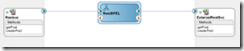
Let us create a very simple SOA Composite which exposes a JSON based REST interface, manipulates the values using Javascript and calls an external JSON based service.

Rest Service

External JSON Service Setup

For external JSON based REST service let us use a dummy JSON Server. Read the complete article here.

SOA & BPM Partner Community

For regular information on Oracle SOA Suite become a member in the SOA & BPM Partner Community for registration please visit www.oracle.com/goto/emea/soa (OPN account required) If you need support with your account please contact the Oracle Partner Business Center.

Blog Twitter LinkedIn image[7][2][2][2] Facebook clip_image002[8][4][2][2][2] Wiki

Processing large XML files in the SOA Suite by Emiel Paasschens


clip_image002Read large XML files in chunks

Introduction

At my current project, XML files are uploaded by the end-user to be processed in the Oracle SOA Suite. The XML files contain information about employers and their employees. Because an employer can have hundreds and even thousands of employees, these XML files can be quite large.
Processing such large XML files consumes a lot of memory and can be a bottleneck especially when multiple end users are uploading large XML files at the same time. It even can cause a server to crash because of an OutOfMemory problem.
The best way to solve is, is to read and process the large XML files in chunks, so read and process XML fragments instead of the full XML file.
My colleague, Aldo Schaap, already did and describes this for CSV files in his blog “Processing large files through SOA Suite using Synchronous File Read“. I thankfully used his blog to do the same for XML processing. However, a few things are slightly different in reading XML instead of CSV, so that’s the reason for this blog.
Another reason is that I ran into another problem, which I will describe later on in this blog. To be able to solve this problem I have to ‘pre transform’ the XML file. This means the XML file needs to be transformed before it is read by the SOA Suite. To achieve this I used the pre processing features of the file adapter with a custom (Java) valve. This pre en post processing is described in the blog “SOA Suite File Adapter Pre and Post processing using Valves and Pipelines” by Lucas Jellema.
The combination of these two blogs provided me the solution for my problem.

Problem Description

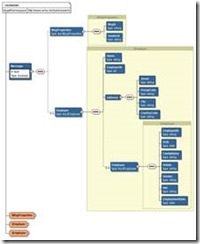
Back to my problem. The large XML files, which have to be parsed, contain one ‘Message’ element as root. This root element contains one or more employers with some basic employers information and each employer can contain multiple employee elements, up to thousands, with employee information and employment information. In the real use case the XML structure contains Dutch element names and the XML is very specific about the business problem. For the purpose of this blog, I’ve reduced the problem to a basic XML structure with English names and used some basic sample data. XSD source: Read the complete article here.

SOA & BPM Partner Community

For regular information on Oracle SOA Suite become a member in the SOA & BPM Partner Community for registration please visit www.oracle.com/goto/emea/soa (OPN account required) If you need support with your account please contact the Oracle Partner Business Center.

Blog Twitter LinkedIn image[7][2][2][2] Facebook clip_image002[8][4][2][2][2] Wiki

SOA & BPM 12.2.1 Installation and Configuration Workshop by John VanSant


clip_image002Overview of Workshop

This workshop will guide the participant through the installation of a non-development environment for SOA and BPM Suite v12.2.1. This workshop won’t cover the installation of the SOA Quickstart install, but the installation of the production software. Some notable differences between the Quickstart install and production bits are:

  • The Quickstart installer doesn’t require an Oracle Database but uses a Java Database. In order to use BAM, an Oracle Database is required so the edelivery installation packages should be used if BAM is going to be used with SOA and/or BPM.
  • The Quickstart installer limits domains to a single managed server.
  • The Quickstart installer doesn’t support B2B domains.
  • The Quickstart installer also doesn’t support the ESS (Enterprise System Scheduler)

The overall steps in this workshop are:

1. Download the software and install Java SE

2. Install Fusion Middleware 12c Foundation

3. Install Oracle Database 12c Enterprise Edition

4. Install SOA and BPM Suite 12c

5. Patch the SOA and BPM 12c installation

6. Create the required Database Schemas to support a domain

7. Create & Configure a test domain

8. Smoke-test the new domain

Read the complete article here. (Community membership required)

SOA & BPM Partner Community

For regular information on Oracle SOA Suite become a member in the SOA & BPM Partner Community for registration please visit www.oracle.com/goto/emea/soa (OPN account required) If you need support with your account please contact the Oracle Partner Business Center.

Blog Twitter LinkedIn image[7][2][2][2] Facebook clip_image002[8][4][2][2][2] Wiki

Master Oracle SOA Suite 12c by Lucas Jellema

clip_image002

Design, implement, manage, and maintain a highly flexible service-oriented computing infrastructure across your enterprise using the detailed information in this Oracle Press guide. Written by an Oracle ACE director, Oracle SOA Suite 12c Handbook uses a start-to-finish case study to illustrate each concept and technique. Learn expert techniques for designing and implementing components, assembling composite applications, integrating Java, handling complex business logic, and maximizing code reuse. Runtime administration, governance, and security are covered in this practical resource.

  • Get started with the Oracle SOA Suite 12c development and run time environment
  • Deploy and manage SOA composite applications
  • Expose SOAP/XML REST/JSON through Oracle Service Bus
  • Establish interactions through adapters for Database, JMS, File/FTP, UMS, LDAP, and Coherence
  • Embed custom logic using Java and the Spring component
  • Perform fast data analysis in real time with Oracle Event Processor
  • Implement Event Drive Architecture based on the Event Delivery Network (EDN)
  • Use Oracle Business Rules to encapsulate logic and automate decisions
  • Model complex processes using BPEL, BPMN, and human task components
  • Establish KPIs and evaluate performance using Oracle Business Activity Monitoring
  • Control traffic, audit system activity, and encrypt sensitive data

For more information please visit the website here. For additional books please visit our SOA wiki here.

SOA & BPM Partner Community

For regular information on Oracle SOA Suite become a member in the SOA & BPM Partner Community for registration please visit www.oracle.com/goto/emea/soa (OPN account required) If you need support with your account please contact the Oracle Partner Business Center.

Blog Twitter LinkedIn image[7][2][2][2] Facebook clip_image002[8][4][2][2][2] Wiki