The quick introduction to the Integration Cloud Service (Oracle PaaS– ICS) by Lucas Jellema

clip_image001

Integration is the term we employ for ‘what ties systems together into end-to-end interaction flows’. Integration describes what we have to do to make applications in one domain talk to those in another, or systems in one enterprise talk to those in another. And to systems running in one cloud interact with those running in another cloud or those running on premises. Integration is ideally approached based on standard based service interfaces and encapsulated implementations. With generic integration facilities handling most of the protocol, format, and technology specific details, and translating interactions as much as possible to standard SOAP and REST exchanges. And with that generic platform handling monitoring, security, system errors and state when asynchronous exchanges are required.

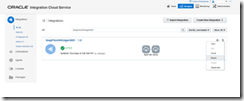
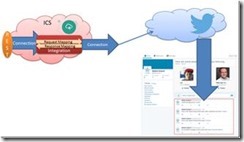
The Oracle Integration Cloud Service (ICS from now on) provides the cloud based integration platform that can run and manage these integration flows. ICS exposes a browser based user interface through which the integration is first designed, then activated and managed. ICS provides adapters to easily interact with a number of popular SaaS applications (Salesforce, Oracle HCM Cloud, Oracle ERP Cloud, Oracle SalesCloud, Service Cloud | Right Now, Eloqua, CPQ, Gmail & Google Task, Evernote, …) and Platform Services and technologies (Oracle Database, Oracle Messaging Cloud Service, FTP, SOAP and REST services) as well as a collection of Social Networks (Twitter, Linked In, Facebook). With ICS it is straightforward to connect to any of these as a target and expose an tailor made, easy to use interface to ICS consumers. Some of these can also be a source for interactions: events in SaaS applications  – such as creation or update of a business object – can trigger ICS to perform an integration flow – pushing data derived from the event to some target.

In this article I will introduce some of the core terminology for ICS and demonstrate my first steps. I will create a SOAP service that exposes a simple operation to convert distances in meters to their equivalent in yards. This service is the based on an existing conversion service offered by a third party. ICS is used to virtualize this service and map to and from between the business friendly interface that I have devised and the pre-existing service interface.

Overview

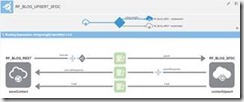
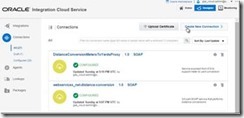
You will see how I have to first create two connections. Connection is the ICS term for an external link – either outbound from ICS to target systems  (comparable to business services in Service Bus or a Reference in SCA composites) or inbound into ICS (from external consumers), similar to Proxy Service in Service Bus and Service in SCA composites. One connection is outbound, to the third party service that does distance conversions. The other connection is inbound – it describes the SOAP interface that I want to expose from ICS to my consumers. Read the complete article here.

SOA & BPM Partner Community

For regular information on Oracle SOA Suite become a member in the SOA & BPM Partner Community for registration please visit www.oracle.com/goto/emea/soa (OPN account required) If you need support with your account please contact the Oracle Partner Business Center.

Blog Twitter LinkedIn image[7][2][2][2] Facebook clip_image002[8][4][2][2][2] Wiki

Oracle OpenWorld 2016 Summaries

image

In case you missed the Oracle OpenWorld 2016 PaaS Partner Update webcast it’s now available on-demand here. Slides from the community webcasts are published here (community membership required)

Thanks to the whole community for the excellent summaries:

· Sven Bernhardt’s OOW 16: My thoughts and experiences

· Phil Wilkins Open World – Key Messages

· Remco Cats Oracle OpenWorld 2016

· Rolando Carrasco‘s Oracle Open World 2016

· Debra Lilley’s My OOW16 – Write Up

· Timo Hahn’s posts Day one & Day 2 & Day 3 & Day 4 & Day 5

SOA & BPM Partner Community

For regular information on Oracle SOA Suite become a member in the SOA & BPM Partner Community for registration please visit www.oracle.com/goto/emea/soa (OPN account required) If you need support with your account please contact the Oracle Partner Business Center.

Blog Twitter LinkedIn image[7][2][2][2] Facebook clip_image002[8][4][2][2][2] Wiki

Oracle OpenWorld on-demand keynotes videos


Oracle Cloud—Built for Continuous Innovation
Thomas Kurian, President of Product Development, Oracle Watch full-length keynote
Complete, Integrated Cloud
Larry Ellison, Executive Chairman and Chief Technology Officer, Oracle Watch full-length keynote

image

SOA & BPM Partner Community

For regular information on Oracle SOA Suite become a member in the SOA & BPM Partner Community for registration please visit www.oracle.com/goto/emea/soa (OPN account required) If you need support with your account please contact the Oracle Partner Business Center.

Blog Twitter LinkedIn image[7][2][2][2] Facebook clip_image002[8][4][2][2][2] Wiki

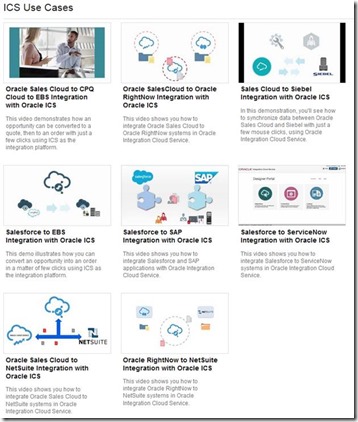
Integration Cloud Service use-cases & get started


Maximize the value of your investments in SaaS and on-premise applications through a simple and powerful integration platform in the cloud. The use-case examples are great tips to get you started and spot opportunities are your customers! Get the use-cases here.

clip_image002

SOA & BPM Partner Community

For regular information on Oracle SOA Suite become a member in the SOA & BPM Partner Community for registration please visit www.oracle.com/goto/emea/soa (OPN account required) If you need support with your account please contact the Oracle Partner Business Center.

Blog Twitter LinkedIn image[7][2][2][2] Facebook clip_image002[8][4][2][2][2] Wiki

Some thoughts on Oracle SOA Cloud Service

clip_image002


Its been a few weeks now since Oracle released its new and highly fanfared SOA Cloud Service.

So what does this mean to Oracle SOA practitioners?. We personally think that this is an important moment in time, because the tide has finally led us to the existence of a fully fledged SOA platform offered in the form of an iPaaS, to go with a whole set of cloud services which already include: Integration, Process Automation, Document/Content Management, Mobile, Identity, etc.

There’s little doubt that digital disruption is and will continue fostering increasingly complex and sizable hybrid architectures. Web APIs have become the toast of the town and mobile-first strategies are at a premium for organizations looking to keep competitive and generate new revenue streams.

Besides the obvious use cases such as sandbox/dev environments and occasional production workload shifting, this is where SOA CS should jump in as a powerful, attainable and ready made enabler for companies looking to invest on digital transformation.

We just wrote a fairly detailed article about all this for Oracle OTN, including an excellent contribution from Dutch stalwart Robert van Mölken. Here’s the direct link:

SOA Cloud Service in a Nutshell

So please enjoy the article and don’t hesitate to ask any questions or post your comments about it. Watch the video here.

SOA & BPM Partner Community

For regular information on Oracle SOA Suite become a member in the SOA & BPM Partner Community for registration please visit www.oracle.com/goto/emea/soa (OPN account required) If you need support with your account please contact the Oracle Partner Business Center.

Blog Twitter LinkedIn image[7][2][2][2] Facebook clip_image002[8][4][2][2][2] Wiki

SOA Cloud Service in a Nutshell by Arturo Viveros, Robert van Molken, and Rolando Carrasco

clip_image002

Introduction

Service Oriented Architecture (SOA) has been present in the Oracle Fusion Middleware Stack for many years now. With varied and powerful options such as Business Process Execution Language (BPEL) Process Manager, Service Bus, Mediator, Business Rules, Business Activity Monitoring (BAM) and others all running on WebLogic Server (WLS) since version 11g, SOA Suite has established itself as the solution of choice for achieving all kinds of on-premises integrations, as well as a comprehensive toolset for enabling the adoption and implementation of Service Orientation design principles.

Furthermore, and looking beyond the tools, SOA itself has evolved into a modern and dynamic architectural style, aligned with business and industry trends and widely regarded as an enabler for technological innovation and digital disruption.

Long gone are the days when SOA adoption was perceived as an almost esoteric ultimate goal, as are the proclamations that left it for dead. After its first generation, SOA reinvented itself and took hold in the IT mainstream. In this regard, SOA Suite has maintained its relevance, despite Oracle’s transformation into a Cloud-first company; so much so that, within a single year, we witnessed first the emergence of a 12c version, an Integration Cloud Service (ICS) built on top of it, and now the delivery of a full-fledged SOA Suite Cloud Service.

In this article we discuss this new offering in detail, together with its implications, possible use cases and scenarios. Along the way, we’ll also attempt to clarify some potentially confusing elements and draw some first-hand conclusions on the present and future of the product.

SOA Cloud Service Overview

First, Oracle has categorized this new offering as an Integration Platform as a Service (iPaaS) alternative, and rightly so. Let’s look at Gartner’s definition for iPaaS:

“…a suite of cloud services enabling development, execution and governance of integration flows connecting any combination of on premises and cloud-based processes, services, applications and data within individual or across multiple organizations”

This is a very broad definition for a cloud-based solution, where Oracle has positioned a lightweight and simplified option in ICS; nevertheless, the need for integration within the cloud increases by the day, which definitely leaves room for much more.

So, this is where SOA Cloud Service comes in, as a ready-made platform for running not only the bona fide functionalities of SOA-Infra and Service Bus, but also API Manager; a recent and very valuable addition to the Fusion Middleware stack (we’ll come back to this later).

Let’s take a look at the components available in this first release: Read the complete article here.

SOA & BPM Partner Community

For regular information on Oracle SOA Suite become a member in the SOA & BPM Partner Community for registration please visit www.oracle.com/goto/emea/soa (OPN account required) If you need support with your account please contact the Oracle Partner Business Center.

Blog Twitter LinkedIn image[7][2][2][2] Facebook clip_image002[8][4][2][2][2] Wiki

SOA Cloud Service, SOA, Cloud, PaaS, Robert Molken, SOA Community,Oracle SOA,Oracle BPM,OPN,Jürgen Kress

Why the Cloud is Like an Orchestra and PaaS the Conductor by Dain Hansen

clip_image002


Musical instruments sound great on their own, but they’re even better when played together: the same applies to cloud services

For many years, cloud adoption was presented as a series of choices. These included such decisions as whether to adopt public or private cloud; or to ignore both and to stick with on-premise enterprise IT systems. Businesses also had to get to grips with a wide variety of services – starting with Software as a Service (SaaS) and then moving swiftly on to Infrastructure as a Service (IaaS) and Platform as a Service (PaaS). This raised further questions: which of these services would benefit them the most? Which should they invest in immediately and for which could they afford to wait?

With the coming of age of cloud computing, it is now clear that while key decisions still need to be made, making the right choices for the business has never been easier. This is because it is now clear that the future for enterprise IT doesn’t lie in the implementation of one or two cloud services (no matter how strategic) so much as in a holistic adoption of the cloud in all its forms. This is because the value of cloud services and infrastructure increases exponentially when delivered as an orchestrated whole.

In the same way the sound of a lone saxophonist is in no way comparable to the power of a full orchestra; likewise, businesses that have a holistic cloud strategy are in a different league to those that run isolated elements of the cloud. While the latter might enjoy productivity and costs benefits in the short term, the former stand to deliver far greater benefits from the complete transformation of their businesses. Read the complete article here.

SOA & BPM Partner Community

For regular information on Oracle SOA Suite become a member in the SOA & BPM Partner Community for registration please visit www.oracle.com/goto/emea/soa (OPN account required) If you need support with your account please contact the Oracle Partner Business Center.

Blog Twitter LinkedIn image[7][2][2][2] Facebook clip_image002[8][4][2][2][2] Wiki

Cloud, PaaS, SOA Community,Oracle SOA,Oracle BPM,OPN,Jürgen Kress

PaaS free trial accounts ICS and PCS, IoT and PaaS for SaaS

image

As part of our communities we do offer free PaaS accounts (only for partners in Europe, Middle East and Africa. In case you are not part of EMEA please contact your local partner manager):

· Integration Cloud Service & Process Cloud Service & SOA Cloud & IoT & PaaS for SaaS Service PaaS Demo Accounts  (Community membership required)

· Java Cloud Service & Application Cloud Container Service & Mobile Cloud Service PaaS Demo Accounts (Community membership required)

Watch the GSE Overview Video! Get an overview of what GSE is and how you can use GSE to help you sell. You can also get long running dedicated PaaS instances, therefore please send us details about your use cases. For instant access please request a sandbox demo

SOA & BPM Partner Community

For regular information on Oracle SOA Suite become a member in the SOA & BPM Partner Community for registration please visit www.oracle.com/goto/emea/soa (OPN account required) If you need support with your account please contact the Oracle Partner Business Center.

Blog Twitter LinkedIn image[7][2][2][2] Facebook clip_image002[8][4][2][2][2] Wiki

Technorati Tags: PaaS,Cloud,ICS,PCS,PaaS4SaaS,SOA Community,Oracle SOA,Oracle BPM,OPN,Jürgen Kress

PaaS 4 SaaS webcast on-demand

clip_image002[4]

Maximize the Value of Your CX Investments with Oracle Cloud Platform

With Oracle CX Cloud, companies not only get the most comprehensive CX offering, but also an innovative and powerful cloud platform to extend, analyze and integrate these applications with the rest of the enterprise resources, as well as to optimize them for every user.  This session outlines the Cloud Platform (PaaS & IaaS) solutions that Oracle provides to streamline cloud development and empowers you to deliver enterprise-grade solutions rapidly and cost effectively. Join this event if you are interested in the most advanced way to extend, analyze and integrate the Oracle CX solutions. In subsequent webinars, we will drive you through further Integration Solutions’ details. Watch the webcast on-demand here.

SOA & BPM Partner Community

For regular information on Oracle SOA Suite become a member in the SOA & BPM Partner Community for registration please visit www.oracle.com/goto/emea/soa (OPN account required) If you need support with your account please contact the Oracle Partner Business Center.

Blog Twitter LinkedIn image[7][2][2][2] Facebook clip_image002[8][4][2][2][2] Wiki

PCS: Form rules in human tasks by Rubén Rodríguez Santiago

clip_image001In Oracle BPM it is possible to use Oracle ADF to implement Human Tasks, but in Oracle Process Cloud Service you can only create a form using web forms. Creating a form is an easy task and it offers us to define rules that it gives us a lot of flexibility to achieve complex requirements.
Having this simple form. We can navigate to rules clicking on the marked button.

For each of the elements we have a number of properties or events that we can manage,
For example we can manage form load event, or get if a field value is valid…

To build the rules we have to use JavaScript and we can get code snippets if we click on the button next to each of the properties.

Let’s build a couple of rules so you can see how easy it is.
Having this combo with this value.

We can build a rules that populates that combo and also add some kind of value change listener so if its value is "Spain" we can set the country code in Telephone field.
If we have any syntax errors, will be displayed in the bottom of the editor. Read the complete article here.

SOA & BPM Partner Community

For regular information on Oracle SOA Suite become a member in the SOA & BPM Partner Community for registration please visit www.oracle.com/goto/emea/soa (OPN account required) If you need support with your account please contact the Oracle Partner Business Center.

Blog Twitter LinkedIn image[7][2][2][2] Facebook clip_image002[8][4][2][2][2] Wiki