Fusion Middleware 12c on the Amazon Cloud by Luigi Banzato

FMW 12c on the Cloud – Part 1: Prepare the Environment

FMW 12c on the Cloud – Part 2: Installation and Configuration

clip_image002Oracle Fusion Middleware 12c is out there. And now it bring the wonders of SOA/BPM quick start, where you can get you development environment setup in 4 clicks. However, at some stage everyone always needs to setup a server, so I’ve been taking a look at how to do that in the cloud.
This is the part 1 of of the tutorial on how to install and configure Fusion Middleware 12c on the Cloud.

Create the EC2 Instance

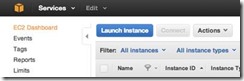
To create the EC2 instance, on the EC2 Console, click on "Launch Instance":

Now select the desired Operational System, here I’ll be using the Amazon Linux:

Read the complete article series here.

SOA & BPM Partner Community

For regular information on Oracle SOA Suite become a member in the SOA & BPM Partner Community for registration please visit www.oracle.com/goto/emea/soa (OPN account required) If you need support with your account please contact the Oracle Partner Business Center.

Blog Twitter LinkedIn image[7][2][2][2] Facebook clip_image002[8][4][2][2][2] Wiki

Cloud Adapter – Advanstar Customers Insights Webcast Went Live Today


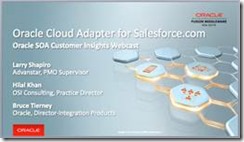
clip_image002When your company tagline is "Connecting our Customers with Theirs", you can’t afford to get integration wrong.   Watch this brief on-demand webcast now to learn why Advanstar chose Oracle integration including the new Oracle Cloud Adapters to replace their legacy integration solution to simplify IT and provide real time synchronization between cloud and on-premise applications.

As you may have seen at Oracle OpenWorld 2014, there has been tremendous interest in the new Oracle Cloud Adapters for simplifying the cloud to on-premises integration challenge.  In this webcast by Advanstar and OSI Consulting, you will learn how Advanstar used the "Oracle Cloud Adapter for Salesforce.com" to connect their sales reps to Oracle E-Business Suite.  As described in the webcast, here were some of the challenges that drove them to the Oracle Solution:

Challenges Prior to the Oracle Solution:

  • Informatica batch integration using a cloud replication service was not acceptable
  • Lack of real-time integration
  • Data replication jobs ran into each other causing conflicts
  • High volume caused increased problems

Oracle Integration Solution Benefits:

  • Simplified cloud integration using the new Oracle Cloud Adapter for Salesforce.com
  • Faster integration of future applications
  • Instant updates for sales reps – real time data synchronization

Read the complete article here.

SOA & BPM Partner Community

For regular information on Oracle SOA Suite become a member in the SOA & BPM Partner Community for registration please visit www.oracle.com/goto/emea/soa (OPN account required) If you need support with your account please contact the Oracle Partner Business Center.

Blog Twitter LinkedIn image[7][2][2][2] Facebook clip_image002[8][4][2][2][2] Wiki

Cloud Computing Definition & Architecture for Cloud Service Brokers

With the launch of the Oracle Cloud PaaS Platforms we will make the SOA & BPM Partner Community cloud ready. In this article series we will lay the foundation for cloud computing including definition and concepts.

clip_image002Content

Cloud Computing Hype Introduction

Cloud Computing Definition and Criteria

Concepts in Cloud Computing

Industry focus & use case Cloud Computing Providers & Consumers

Differences between Cloud Definitions

NIST Cloud Computing Reference Architecture

Cloud Broker

Types Cloud Broker

Challenges Cloud Broker

Cloud Computing Hype Introduction
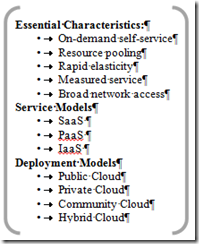
image Why is everyone talking about cloud computing? Drawn-out, expensive IT projects that are planned and implemented with few benefits for the business stakeholders are commonplace. In contrast, cloud computing offers business users the chance to immediately implement services with usage-based billing that are tailored to their requirements, often without the need to consult with the IT department.

However, aspects including security, architecture, availability, and standards are often not evaluated. Cloud consumers find themselves at the mercy of the cloud provider. Scenarios that require changing cloud providers after a cloud provider goes bankrupt, and the associated moving of data and/or applications, have not yet been sufficiently tested. Business continuity should play a key role from the start of a cloud evaluation process.

One of the greatest challenges here is the integration of existing data and systems into the cloud solution. Without integration spanning clouds and on premise systems, processes can only be executed in isolation, leading to cloud-specific silos of isolated solutions. Important information for users is not available across processes and systems. Problems that would have occurred in the company’s internal IT are now shifted to the cloud provider. To prevent "legacy clouds" or solutions that are hard to maintain, it is important to manage the entire architecture proactively and, in particular, the integration into the cloud. Even if cloud providers want us to believe otherwise, not every aspect of IT can be outsourced to cloud solutions!

Cloud Computing Definition and Criteria

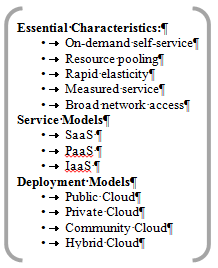
Cloud computing is a model for usage-based network access to a common pool of configurable computing resources (e.g. networks, servers, storage systems, applications, and services) that can be provided and used quickly. IP-based services are requested via self-service and used online independently. A prerequisite for this is a broadband Internet connection with low latency. The IT resources are bundled into pools and provided as required. Billing is based on the services used. *1

Concepts in Cloud Computing

In cloud computing, the following models are differentiated on the basis of horizontal scaling:

· Infrastructure-as-a-Service (IaaS) – provides a hardware platform as a service, such as Amazon EC2 or Oracle Compute Service (now in preview)

· Platform-as-a-Service (PaaS) – provides a software platform as a service, such as Google Apps Engine or Oracle Java Cloud

· Software-as-a-Service (SaaS) – allows applications and functions to be outsourced by virtualizing cloud providers’ hardware and software and providing the functions as services, such as Salesforce CRM [REF-1] or Oracle Sales Cloud

In deployment models, distinctions are made according to availability and installation location. Public clouds are services that are available to the public on the Internet. Private clouds are internal company services. Hybrid clouds and community clouds represent mixtures of these models, such as when Amazon computing power is used in the event of a failure or overload of an internal company cloud application.

Industry focus & use case Cloud Computing Providers & Consumers
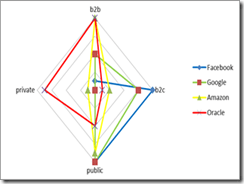
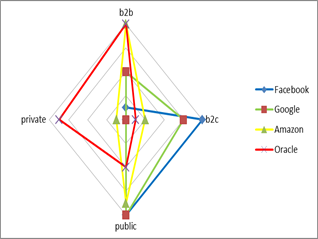
clip_image005Large companies for which IT plays a central role or represents a competitive advantage often build internal company cloud solutions in their own data centers “private clouds”. Small and medium enterprises frequently use public cloud services. A further distinguishing feature is the cloud consumer focus. In the business-to-business segment, private clouds are predominantly used, while in the business-to-consumer segment the majority are public clouds (Figure: 1).

Differences between Cloud Definitions

Thomas Erl, Ricardo Puttini and Zaigham Mahmood define cloud computing in his latest book “Cloud Computing Concepts, Technology & Architecture”. Based on the NIST cloud computing definition they add “ubiquitous access” as a cloud characteristic, to reflect the trend that more and more services are used on mobile devices. As cloud computing becomes more and more adopted also in b2b services, companies run mission critical applications on a global level in the cloud, resiliency of this services becomes important. Therefore Thomas Erl Ricardo Puttini and Zaigham Mahmood add also “resiliency” to the cloud characteristics.*2

Wikipedia defined cloud computing more from a consumer perspective. The article highlights that cloud computing is often used as a jargon term without a commonly accepted non-ambiguous scientific or technical definition.*3. From my perspective the NIST definition is widely accepted between b2b vendors. Many software vendors try to brand their solutions as cloud solution, or cloud enabled solutions without to respect the NIST cloud definition. This reflects the change of the IT industry caused by cloud computing.

NIST Cloud Computing Reference Architecture

Together with the “The NIST Cloud Definition of Cloud Computing” the “NIST Cloud Computing Reference Architecture” lays the theoretical foundation of cloud computing. The NIST Cloud Computing Reference Architecture extends the definition by a reference architecture and a taxonomy. An additional actor and role model is introduced. The cloud provider offers IaaS, PaaS or SaaS services to the cloud consumer. Between them a cloud broker might offer service intermediation, service aggregation and service arbitrage. These services become more important as cloud services need to be integrated with on premise and integrated or exchanged between different cloud providers. A cloud carrier transports the cloud services from the cloud provider to the cloud consumer. A cloud auditor might support the cloud consumer and cloud provider in security, privacy impact and performance audits*4

Cloud Broker

NIST and Gartner define three different types of cloud brokers:

Service Intermediation

Provides value added services on top of a cloud platform. An example is the Force identity service from Salesforce. This identity service can be used to identify users across several cloud services.

Service Aggregation

Ensures the interoperability between different cloud services. An example is Boomi from Dell. The service let cloud consumers integrate for example a Salesforce CRM system with a Netleger billing system and or an on premise solution. As IT System are often historical grown and rally build on a green field approach cloud aggregation becomes key for cloud adoption.

Service Arbitration

A cloud service arbitrage provides flexibility and an “opportunistic choices” by offering multiple similar services to select from.*5 Heroku for example lets the cloud consumer choose between different cloud services. The cloud consumer might increase service level agreements or reduce the dependency from one cloud provider by a service arbitration service.

Key Benefits of Cloud Brokers

Key benefits of cloud brokers might include:

• Cloud interoperability: Integration between several cloud offerings

• Cloud portability: Move application between different cloud vendors

• Different data models between cloud offerings

• Modular services between several cloud offerings e.g. security, document or notification services to increase developer productivity and user usability & security

• Increase business continuity by reducing dependency from one cloud provider

• Increase SLAs by leverage multiple cloud provider

Challenges Cloud Brokers

Large leading cloud providers e.g. Google or Salesforce try to offer comprehensive services & platforms for cloud consumers. Often they are not interested to enable cloud broker services which might enable cloud consumer to choose or broker between different cloud providers. Sometimes their strategy can be characterized as a vendor log-in. Today no industry wide standard for cloud brokers is developed. To enable seamless service aggregation on a process level, between different cloud providers a meta-data model between them needs to be established. This model needs to include joint business objects and services to ensure seamless processes across multiple cloud providers.

Cloud consumers Dependencies based on Service Layer

The risk of such a vendor login might be based on the service model the cloud consumer chooses. The higher the service model, less has to build by the cloud consumer, more is provided by the cloud provider, the higher the risk of vendor login:

Service Model

Risk vendor login

Advice

SaaS

High

Same application on-premise available

PaaS

Medium

Standard programming language available several clouds

IaaS

Low

Operating & Virtualization technologies

With the need of cloud Brokers versus the trend to build whole cloud Economies by one dominant player this might be one of the most challenging and exciting areas of cloud computing in the next years. Today cloud consumers might carefully evaluate this in the cloud selection phase to ensure business continuity.*6

References

  1. NIST Definition Cloud Computing
  2. „Cloud Computing Concepts, Technology & Architecture” Thomas Erl, Zaigham Mahmood, Ricardo Puttini, PRENTICE HALL June 2013
  3. Wikipedia http://en.wikipedia.org/wiki/Cloud_computing
  4. NIST Cloud Computing Reference Architecture
  5. Gartner
  6. NIST Definition Cloud Computing

For more information on Cloud Integration please visit www.soacommunity.com

SOA & BPM Partner Community

For regular information on Oracle SOA Suite become a member in the SOA & BPM Partner Community for registration please visit www.oracle.com/goto/emea/soa (OPN account required) If you need support with your account please contact the Oracle Partner Business Center.

Blog Twitter LinkedIn image[7][2][2][2] Facebook clip_image002[8][4][2][2][2] Wiki

SOA Community,Oracle SOA,Oracle BPM,OPN,Jürgen Kress. Cloud, cloud service broker, cloud integration
Computer World Cloud Report

clip_image002

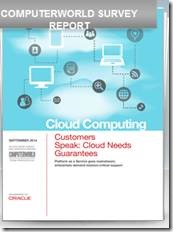
Please see below the link to a recent ComputerWorld report sponsored by Oracle about customer requirements and adoption as it relates to Platform as a Service.
Great asset to read and share with your customers & prospects. Get the cloud report here.

Additional at Financial times Oracle published a special page for cloud computing, visit it here.

SOA & BPM Partner Community

For regular information on Oracle SOA Suite become a member in the SOA & BPM Partner Community for registration please visit www.oracle.com/goto/emea/soa (OPN account required) If you need support with your account please contact the Oracle Partner Business Center.

Blog Twitter LinkedIn image[7][2][2][2] Facebook clip_image002[8][4][2][2][2] Wiki

Applications Cloud Release 8 User Experience Rapid Development Kit

clip_image001

If you’re building or integrating the Oracle Applications Cloud or building SaaS through PaaS, use the User Experience Rapid Development Kit laid out here to get the guidance you need and point you to the right tools to use.

The Oracle Applications User Experience team has released a User Experience Rapid Development Kit on simplified user interface (UI), the same user experience design in Oracle Applications Cloud release 8. The kit is designed to help Oracle ADF developers get up to speed quickly so they can start designing and building the Oracle Applications Cloud simplified UIs, which are the tablet-friendly UIs for Oracle Sales Cloud and Oracle HCM Cloud, in a matter of hours.

The User Experience Rapid Development Kit contains the following tools:

  • Coded ADF page templates.
  • Coding tips from Oracle’s developers.
  • ADF screen overlays showing the use of components in the simplified UI.
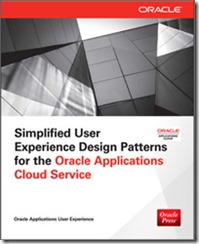
  • An eBook on user experience (UX) design patterns and guidelines(right), and example wireframe stencils of page types and components in Microsoft Visio and Balsamiq Mockups formats.
  • Sample wireframe of a simplified UI page flow.

How would you like to get started?

Tell me more about the simplified user interface for Oracle Applications Cloud.

Show me demos of simplified UI in the Oracle Applications Cloud.

What’s coming next in the Oracle Applications Cloud user experience?

Start Designing and Building a Simplified User Interface

Learn more

SOA & BPM Partner Community

For regular information on Oracle SOA Suite become a member in the SOA & BPM Partner Community for registration please visit www.oracle.com/goto/emea/soa (OPN account required) If you need support with your account please contact the Oracle Partner Business Center.

Blog Twitter LinkedIn image[7][2][2][2] Facebook clip_image002[8][4][2][2][2] Wiki

Smart Combo – Cloud Integration Webcast January 26th 2015

clip_image002

Cloud Integration – Unified and Comprehensive Cloud and On-premise Integration Discover the Value for Partners

Simplify cloud integration with a unified and comprehensive solution to integrate disparate cloud and on-premise applications. Oracle cloud integration leverages Oracle Cloud services as well as components from Oracle’s SOA, BPM, and data integration technologies.

Speakers will be:
– Olivier Tordo, Channel Sales – Senior Director
– Richard Lefebvre, Director CRM Partner Programs EMEA
– Christian Patrascu, Director of Product Management – Oracle
– Yogesh Sontakke, Principal Product Manager

Details and registration: » 26 January – 2 PM CET (1 hour)

SOA & BPM Partner Community

For regular information on Oracle SOA Suite become a member in the SOA & BPM Partner Community for registration please visit www.oracle.com/goto/emea/soa (OPN account required) If you need support with your account please contact the Oracle Partner Business Center.

Blog Twitter LinkedIn image[7][2][2][2] Facebook clip_image002[8][4][2][2][2] Wiki

Cloud Adapter for Salesforce.com – Understanding What It Does & How You Benefit by ITC

Starting in the 1990’s it became standard operating procedure in all large and even mid-sized companies to use an ERP system  such as Oracle E-Business Suite to manage business processes like Order Management, Accounting System or Supply Chain Management, along with the complete sales and revenue cycle from quote-to-order and order-to-cash.

clip_image002However, as recently as only a half-decade ago, those same companies either ran CRM systems completely independently of those ERP solutions or they scarified high quality CRM functionally for a CRM alternative that was “good enough”  but integrated easily with Oracle.
However, this began to change at the beginning of the second decade of the 21st century, as companies began dropping their legacy systems and opting to move to SaaS-based CRM solutions such as SalesForce.com.  The attraction of solutions such as Salesforce.com is twofold: first, they offer best of breed functionality; second, the SaaS model makes them very attractive from a total cost of ownership perspective. 
However,  the downside that Oracle users face when they adopted a SaaS solution such as SalesForce.com was that it didn’t integrate with Oracle E-Business Suite. And this creates problems such as data silos, data scattering, data quality issues and other major inefficiencies related to business process execution. Maintaining your data also becomes a challenge, as data captured across your system must be duplicated to SalesForce.
To overcome these issues and take full advantage of Oracle EBS and SalesForce.com organizations need to achieve a seamless information flow between the two: they need to integrate them. This much has long been obvious. Read the complete article here.

SOA & BPM Partner Community

For regular information on Oracle SOA Suite become a member in the SOA & BPM Partner Community for registration please visit www.oracle.com/goto/emea/soa (OPN account required) If you need support with your account please contact the Oracle Partner Business Center.

Blog Twitter LinkedIn image[7][2][2][2] Facebook clip_image002[8][4][2][2][2] Wiki

Cloud demystified Open World 2014 Overview of Cloud offerings by Amis team

clip_image002The central theme of Oracle Open World 2014 has certainly been the Cloud. Downtown San Francisco was laced with banners about Oracle and Cloud. The difference compared to last year is that now there is a huge amount of real cloud products available (or soon to be launched). Where the Oracle cloud offering till this summer was limited to Database and Java (WebLogic) and some applications the current stack ranges from infrastructure till a range of SAAS offerings. The amount of cloud related announcements was really huge and somewhat overwhelming. Get things in perspectives I have drafted below a list of the concrete cloud offerings with a short description. If you want to try this in practice you are welcome to visit https://cloud.oracle.com/home (choose the platform tab to see what’s currently available).

The major theme of all Oracle cloud based solutions is REST support for all commands. So you can use either Cloud Control / Enterprise Manager to manage your cloud infrastructure or you can directly tap into the specific systems and manage them yourself. In this way you can customize the management of your infrastructure for specific services without having to use the Cloud Control.

Overview of all cloud offerings Oracle has introduced last week at Oracle Open World 2014:

Java Cloud

The Java Cloud offering, also called WebLogic Cloud, is a full version of WebLogic Server as a cloud instance. Including the usage of Coherence as a data grid within the WebLogic Server to share data and transactions between several applications without using the round-trip to the database. At this time Oracle is offering WebLogic 11c and 12c as a cloud service. Within the cloud dashboard you are able to create and scale your Java cloud service as you like (scale up and scale out).

Security cloud Services

Oracle has made security a high priority within the cloud services offering. This is essential for the complete cloud offering. The the security cloud service offers firewall, intrusion detection and anti-virus to protect the system from treats from outside the infrastructure and prevent systems being attacked by systems within the cloud infrastructure. This offering enables you to configure your cloud system to be compliant with a lot of regulatory frameworks (http://www.oracle.com/us/media1/service-cloud-security-overview-2030360.pdf)

Developer Cloud

New announcement is the developer cloud is a new offering consisting of tools for software repository, wiki, issue / task tracking and build engine. The developer cloud will be released in the upcoming moth. A trial version is already available. According to my information the Developer Cloud is free together with the Java Cloud.  With the developer cloud you are able to create a GIT repository (or multiple) and invite your team to participate. You can connect your own IDE (Eclipse, JDeveloper etc.) to this repository and work just as you were used to work. The developer cloud offers an issue tracking system based upon the schema of Bugzilla with an integrated interface and REST interfaces to create and tasks from your own IDE. The build engine in the developer cloud is based upon Mave3 and Hudson. And finally you can use a wiki in the developer cloud to enrich your documentation. The developer cloud is aimed on working in agile projects and supports easy and fast review, collaboration and quick integration. The developer cloud offers to create and use templates. This enables you to create a template of a specific type of project and use this as a basis for following similar project while copying a pre format setup of the source repository, build engine and wiki.

Integration Cloud (SOA / Service Bus )

This service enables the SOA and OSB users to leverage the advantages of integration with Service Bus and SOA and the scalability and availability of cloud systems. This product is announced on Open World and it looks like it is being launched introduced in the upcoming months. A very interesting part of this is the Cloud Adapter SDK. Integration Cloud Services (ICS) offers a lot of new SaaS adapters to integrate with SaaS applications like SalesForce for example. The cloud adapters are built in the Cloud Adapter SDK and written in Java. So you are able to create your own adapter an share this adapter with your users. http://www.oracle.com/technetwork/middleware/adapters/documentation/index.html

Process cloud

Another new service is the Process Cloud. This is the cloud implementation of BPM with the goal of offering a simplified and comprehensive way of modeling and executing your processes. The goal is to migrate the BPM creation activities from the developer to the business analyst. The process cloud is being launched soon. Examples are available here : https://cloud.oracle.com/process

Analytics Cloud / BI Cloud

This is the Business Intelligence offering as a cloud service. This service is being made available as a separate offering and as an BI Engine on other Oracle applications like Oracle Eauola and Oracle RightNow. (https://cloud.oracle.com/business_intelligence).

Mobile Cloud and Mobile Application Accelerator (MAX)

Oracle Mobile cloud is an extensive way to make your own services available as a mobile backend. The mobile could offers services to create data providers within for your mobile developer without bothering them with the complexity of your enterprise backend. Including shielding the security of your connection from your mobile developers. The mobile cloud offers several features for reporting and analytics such as usage statistics and engagement. This service will probably be launched in a few months (https://cloud.oracle.com/mobile) . A second interesting announcement was the introduction of MAX ( Mobile Application Accelerator). The Oracle Mobile Application Accelerator feature allows users with no coding experience to rapidly and intuitively produce mobile applications. This feature is only announced and it is not clear when it will be available for usage. Read the complete article here.

SOA & BPM Partner Community

For regular information on Oracle SOA Suite become a member in the SOA & BPM Partner Community for registration please visit www.oracle.com/goto/emea/soa (OPN account required) If you need support with your account please contact the Oracle Partner Business Center.

Blog Twitter LinkedIn image[7][2][2][2] Facebook clip_image002[8][4][2][2][2] Wiki

What is Oracle Developer Cloud Service?

clip_image001

An introduction to the world of Oracle Developer Cloud Service. For more information, see the documentation. To test the Developer Cloud Service please click here.

SOA & BPM Partner Community

For regular information on Oracle SOA Suite become a member in the SOA & BPM Partner Community for registration please visit www.oracle.com/goto/emea/soa (OPN account required) If you need support with your account please contact the Oracle Partner Business Center.

Blog Twitter LinkedIn image[7][2][2][2] Facebook clip_image002[8][4][2][2][2] Wiki

Enterprise Manager Cloud Control 12c: Best Practices for Middleware Management free on-demand training

clip_image002This self-paced course teaches you best practices when using Oracle Enterprise Manager Cloud Control 12c for managing your WebLogic and SOA applications and infrastructure. It consists of interactive lectures, videos, review sessions, and optional demonstrations.

This course covers Enterprise Manager Cloud Control 12c licensed with the WebLogic Server Management Pack Enterprise Edition and the SOA Management Pack Enterprise Edition. Watch the training here.

SOA & BPM Partner Community

For regular information on Oracle SOA Suite become a member in the SOA & BPM Partner Community for registration please visit www.oracle.com/goto/emea/soa (OPN account required) If you need support with your account please contact the Oracle Partner Business Center.

Blog Twitter LinkedIn image[7][2][2][2] Facebook clip_image002[8][4][2][2][2] Wiki