Poll a Microsoft Exchange mailbox from OSB using DavMail by Laurens van der Starre


clip_image002The Oracle Service Bus has built in features to poll an IMAP of POP3 mail account. There are loads of excellent blog posts that exactly describe how to do it. However, when the mail server happens to be a Microsoft Exchange server, things become shady. Exchange’s IMAP implementation tends to be not really that compatible, and the server log will fill up with stacktraces such as:

Of course we can connect using the Exchange Web Services (EWS) using the OSB, but that is loads of work. Luckily there is DavMail. DavMail is an gateway that sits in between Exchange and your third party mail clients. Using DavMail, you can connect using simple POP3 or IMAP protocols to DavMail which in turn connects to Exchange using the EWS. DavMail is build in java, and runs happily on WebLogic Server.

So, download DavMail’s WAR distribution for SourceForge. Unpack the WAR-file and edit the properties file in WEB-INF/classes.

Set is to run in Server mode, and let it know where the EWS is: Read the complete article here.

SOA & BPM Partner Community

For regular information on Oracle SOA Suite become a member in the SOA & BPM Partner Community for registration please visit www.oracle.com/goto/emea/soa (OPN account required) If you need support with your account please contact the Oracle Partner Business Center.

Blog Twitter LinkedIn image[7][2][2][2] Facebook clip_image002[8][4][2][2][2] Wiki

Consuming OAuth protected resources using Oracle Service Bus article series by Milco Numan


clip_image002In this blog post, I will provide a general introduction of REST, explain some of the choices made and lay some of the ground work. The second part of this blog series will discuss the token management part while the third and final part describes the actual creation of the SOAP services providing the proxy to the external REST APIs.

With the introduction of SOA Suite 12c, the Oracle JCA REST adapter was introduced for use in both SOA and Service Bus 12c. This enables SOA developers to expose REST interfaces to their service consumers. A study by the Oracle A-team shows that in certain scenarios response times on mobile platforms may be reduced by an order of magnitude by consuming REST services instead of their SOAP equivalents.

However, using the REST adapter you cannot only expose REST interfaces to your own service implementations (inbound REST), but you can also consume REST services (outbound REST). In this series of blogs, I will demonstrate how I implemented a use case of “outbound” API management for a proof of concept, where the REST services were exposed as SOAP web services to our internal clients (which are largely “REST unaware”). An additional dimension is provided by the fact that the REST APIs invoked are secured by OAuth 2.0, so also some token management is needed in order to successfully invoke the service.

What about Security?

I am glad you asked. As SOAP has quite a number of standardized extensions in the realms of orchestration and security, this is very much “terra incognita” in the REST world. Well, not really. As REST is leveraging the HTTP protocol as the transport mechanism, a first step in security would be to use HTTPS (HTTP over SSL) to prevent an intermediary from eavesdropping on the communication between the service and the client. However, this will only prevent the interception of messages, it does not provide the server with any method of determining the origin of the request. Using HTTP Basic Authentication may be an option to force the client to sent some identification to the server, but the problem is that this scenario is not very useful for application to application message exchange as it does not provide options to provide temporary access or to revoke the access.

Enter OAuth, “an open protocol to allow secure authorization in a simple and standard method from web, mobile and desktop applications.” Version 2.0 of this protocol has been published in 2012 and is widely in use for securing access and authorization to services, e.g. Google, LinkedIn, Facebook, Dropbox and Paypal to name a few.

What is REST?

What is REST? And how does if differ from SOAP? Well, first of all REST and SOAP are intended to access (remote) Web Services. Where SOAP is a heavy-weight protocol, involving predefined message structures and formats, REST is defined very loosely as an “architectural style”. Messages transmitted to SOAP web services are always encoded as XML data structures, whereas the payload in REST can be either XML or JSON. The latter seems to be the preferred format nowadays, I came across a site describing JSON as “The Fat-Free Alternative To XML“.

In REST, you are manipulating “resources” (types of objects, e.g. customers, orders, items and the like) using standard HTTP methods. You’d use the GET method on a resource to retrieve a single instance or collection, use the HTTP POST method to create a new one, update a resource instance using HTTP PUT and the HTTP DELETE takes care of removing an object. Read part 1 here and read part 2 here and read part 3 here

SOA & BPM Partner Community

For regular information on Oracle SOA Suite become a member in the SOA & BPM Partner Community for registration please visit www.oracle.com/goto/emea/soa (OPN account required) If you need support with your account please contact the Oracle Partner Business Center.

Blog Twitter LinkedIn image[7][2][2][2] Facebook clip_image002[8][4][2][2][2] Wiki

No More Hidden SOA Performance Problems by Kevin King


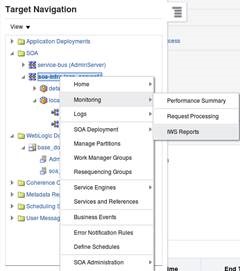
clip_image002For anyone who has done performance and load testing in Oracle SOA suite, you know it can be frustrating and time consuming. However, our lives have just gotten much easier! Originally, quite a bit of manual work was needed to find or calculate how long composites took, what the problematic components were, and why instances just took too long. Fortunately, Oracle has introduced a new monitoring tool, Integration Workload Statistics (IWS). This tool creates a report very similar to an AWR report, but focuses on the SOA infrastructure. This feature was released with the new 12.2.1 version of SOA.

Integration Workload Statistics

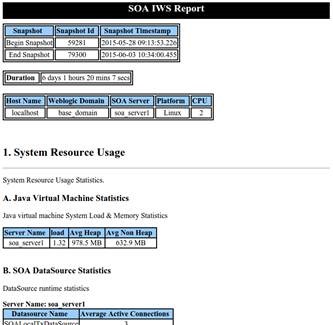
clip_image004The IWS report is intended for reactive monitoring of your system. Enterprise Manager provides a few different tools for monitoring real-time performance and other metrics, however IWS was introduced to post-process poorly performing periods. Running a report over a one hour period where performance is a constant issue allows you to see what components are causing delays. The report details out statistics on components, composites, processes, adapters, endpoints, queues and more!

IWS works by taking periodic, configurable snapshots of server metrics. These metrics are stored to the database and are available for reporting. The reports are generated based on a start and end time and further filtering can be done by server, partition, and even specific composites. Oracle has provided an easy way to view this data with a generated HTML report and they also provide a CSV file, or XML file with the data requested. 

The report (assuming FINEST level collection) consists of:

Stream Analytics (Stream Explorer Version 2) ISW immersion Sales and Technical Training Event April 19th & 20th London UK

clip_image002


The industry leading Real Time Streaming Analytics platform has arrived – Customer General Availability– April 28th.

Last year we released V1, Oracle Stream Explorer, with its new approach to providing customer streaming solutions in minutes rather than months, exploded adoption of the platform with deal sizes growing to the millions $$$. 2016 now reveals a massively enhanced platform which according to the analysts and customers changes the game to place Oracle as the industry leader.

The training will cover:

OSA for Sales: How to sell, why sell across all industries, domains and enhancing other compelling Oracle offerings, Big Data (Fast Data), Data Integration, IOT. Addressing the demand for FOG, on premise, hybrid and cloud services.

OSA for Technical: Basic foundational, intermediate and advanced hands-on intensive labs including – Visual GEOProcessing, our revolutionary new Streaming Predictive Machine Learning, Streaming Business Rules, Expression Builder, Topology viewer, Connection and Target profiling, Coherence and extended Event source/sink streaming end-points such as Kafka, MQTT.

How to use the new integrated Spark Streaming infrastructure, Cloud enablement, Services, now and arriving this year. LIMITED SPACE – Send an email to register and reserve a seat.

SOA & BPM Partner Community

For regular information on Oracle SOA Suite become a member in the SOA & BPM Partner Community for registration please visit www.oracle.com/goto/emea/soa (OPN account required) If you need support with your account please contact the Oracle Partner Business Center.

Blog Twitter LinkedIn image[7][2][2][2] Facebook clip_image002[8][4][2][2][2] Wiki

SOA Suite Review The platform comes with a standalone, first-class Service Bus component that can be used for service virtualization by Sven Bernhardt

clip_image002


Valuable Features:

A definitive differentiator is the very good integration capability the platform provides: It has a broad spectrum of connectivity adapters to integrate with third party enterprise information systems, like SAP, Siebel, and JD Edwards, and also cloud solutions like Salesforce.

In addition, the platform comes with a standalone, first-class Service Bus component that can be used for service virtualization. This enables customers to create and edit new integrations efficiently and helps to adopt new trends or concepts, like cloud, very fast.

Aside from that, the platform also addresses business needs (process automation with BPEL), allows for further transparency for business transactions (audit trails, Business Activity Monitoring) and provides rich capabilities in the direction of fault handling and resiliency.

Improvements to My Organization:

The product allows you to visualize how a company is working currently by providing rich possibilities for analyses such as the audit trails and real-time integration and business insights, and therefore shows where improvements might be valuable. This becomes more and more important for companies to differentiate themselves from competitors.

Room for Improvement:

The Integrated Development Environment (IDE), which is JDeveloper in this case. Also, the integrated development environment could be better in some points such as the stability and the comprehensibility of errors.

Use of Solution:

I’ve used it for over eight years in different projects, in different industrial sectors, and with different project focuses, ranging from pure integration scenarios to process automation and optimization projects. Read the complete article here.

SOA & BPM Partner Community

For regular information on Oracle SOA Suite become a member in the SOA & BPM Partner Community for registration please visit www.oracle.com/goto/emea/soa (OPN account required) If you need support with your account please contact the Oracle Partner Business Center.

Blog Twitter LinkedIn image[7][2][2][2] Facebook clip_image002[8][4][2][2][2] Wiki

ICS + Twitter by Rolando Carrasco

clip_image002

From the series of articles that we have been posting on this blog about Oracle ICS, it is now time to talk about the connector that exists for Twitter.

With this connector you can make Outbound operations to Twitter.

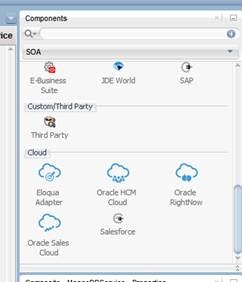
In the past, we have already written (http://oracleradio.blogspot.mx/2016/02/oracle-integration-cloud-service-parte.html) a post in which we mentioned the list of connectors that Oracle ICS have available for use:

One of them is exactly Oracle Twitter Cloud .

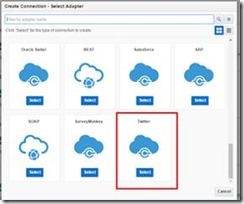
The connection is made as any oher connection inside the ICS, meaning this that you should go to the connections section and create a new one:

After this is done, you have to select the Twitter connection: Read the complete article here.

SOA & BPM Partner Community

For regular information on Oracle SOA Suite become a member in the SOA & BPM Partner Community for registration please visit www.oracle.com/goto/emea/soa (OPN account required) If you need support with your account please contact the Oracle Partner Business Center.

Blog Twitter LinkedIn image[7][2][2][2] Facebook clip_image002[8][4][2][2][2] Wiki

SOA and Integration On-Prem and in the Cloud


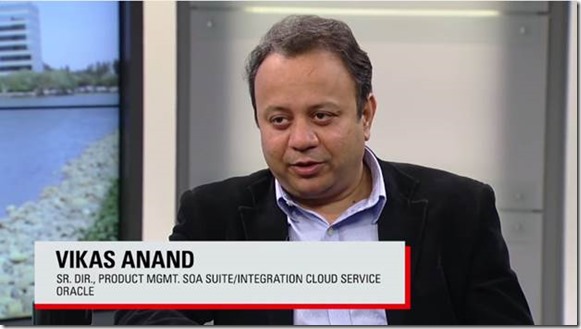
Vikas Anand (Senior Director, Product Management, SOA Suite/Integration Cloud Service, Oracle) and Ram Menon (Product Manager, Oracle Integration Cloud Service) join OTN TechCast host Bob Rhubart for a discussion about meeting SOA and integration challenges on-prem and in the cloud.

clip_image002

Watch the video here.

SOA & BPM Partner Community

For regular information on Oracle SOA Suite become a member in the SOA & BPM Partner Community for registration please visit www.oracle.com/goto/emea/soa (OPN account required) If you need support with your account please contact the Oracle Partner Business Center.

Blog Twitter LinkedIn image[7][2][2][2] Facebook clip_image002[8][4][2][2][2] Wiki

Cloud Adapter SDK – Part 2: Functionality by Jeroen Ninck

clip_image002


Introduction

So this is part 2 of a series of blog post describing building a Cloud Adapter for MongoDB. In this part I want to discuss the functionality I want to achieve.

I will use Windows 10 and PowerShell (my favourite Windows shell!) for these blogs. All sources can be found on GitHub.

Parts:

Just a small warning: Always keep track of Oracle license information and the Oracle certification matrix!

What should it do?

MongoDB has a lot of features we might want to expose in the Cloud Adapter. However I want to start relative simple and I might expend the functionality in the feature. So I want to start with inserting data. A second step will be to find the data by querying it.

MongoDB

MongoDB is a NoSQL database and stores documents. These documents are basically JSON documents (actually BSON):

{
                    "_id" : ObjectId("56fa75781f1378215c215709"),
                    "field1" : "value1"
}

Basically there are no foreign keys. Of course you refer to other documents, however these is no foreign key like in a relational database. Each document does have a primary key called _id (which is of type ObjectId). A document is stored in a collection and a MongoDB database can have multiple collections. A single instance of MongoDB can host multiple databases. Read the complete article here.

SOA & BPM Partner Community

For regular information on Oracle SOA Suite become a member in the SOA & BPM Partner Community for registration please visit www.oracle.com/goto/emea/soa (OPN account required) If you need support with your account please contact the Oracle Partner Business Center.

Blog Twitter LinkedIn image[7][2][2][2] Facebook clip_image002[8][4][2][2][2] Wiki

Uploading files to Oracle Document Cloud Service using SOA by Shreenidhi Raghuram

clip_image002

This blog provides a quick tip for implementing file upload into Oracle Document Cloud Service (DOCS) using java in Oracle SOA and Oracle SOA Cloud Service(SOACS)

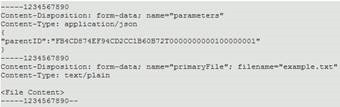
The DOCS upload REST service requires POSTing of multipart form, a feature that is currently unavailable in the REST cloud adapter. This POST request to upload a file contains 2 body parts. The first being a json payload and the second containing the actual file content.

The request format looks as shown here in the Oracle Documents Cloud Service REST API Reference.

The section below shows a java embedded block of code that can be used within a BPEL process to achieve the file upload. This can be used in Oracle SOA and SOACS – BPEL composites. A valid DOCS endpoint, credentials for authorization, and a GUID of the folder location for the file upload are required to execute this REST call.
In this sample, a pdf document file is being uploaded into DOCS. The media type should be appropriately changed for other content formats.
Also, It is recommended to access the authorization credentials from a credential store when developing for production deployments. This section is only intended as a demo. Read the complete article here.

SOA & BPM Partner Community

For regular information on Oracle SOA Suite become a member in the SOA & BPM Partner Community for registration please visit www.oracle.com/goto/emea/soa (OPN account required) If you need support with your account please contact the Oracle Partner Business Center.

Blog Twitter LinkedIn image[7][2][2][2] Facebook clip_image002[8][4][2][2][2] Wiki

Integration Cloud Service (ICS): A developer’s first impression by Maarten Smeets

clip_image001


Oracle provides ICS (Integration Cloud Service) as a simple means for citizen developers to do integrations in the cloud and between cloud and on-premises. On the Oracle Fusion Middleware Partner Community Forum I got a chance to get some hand-on experience with this product in one of the workshops. In this blog post I will describe some of my experiences. I’m not the target audience for this product since I am a technical developer and have different requirements compared to a citizen developer. I’ve not been prejudiced by reading the documentation

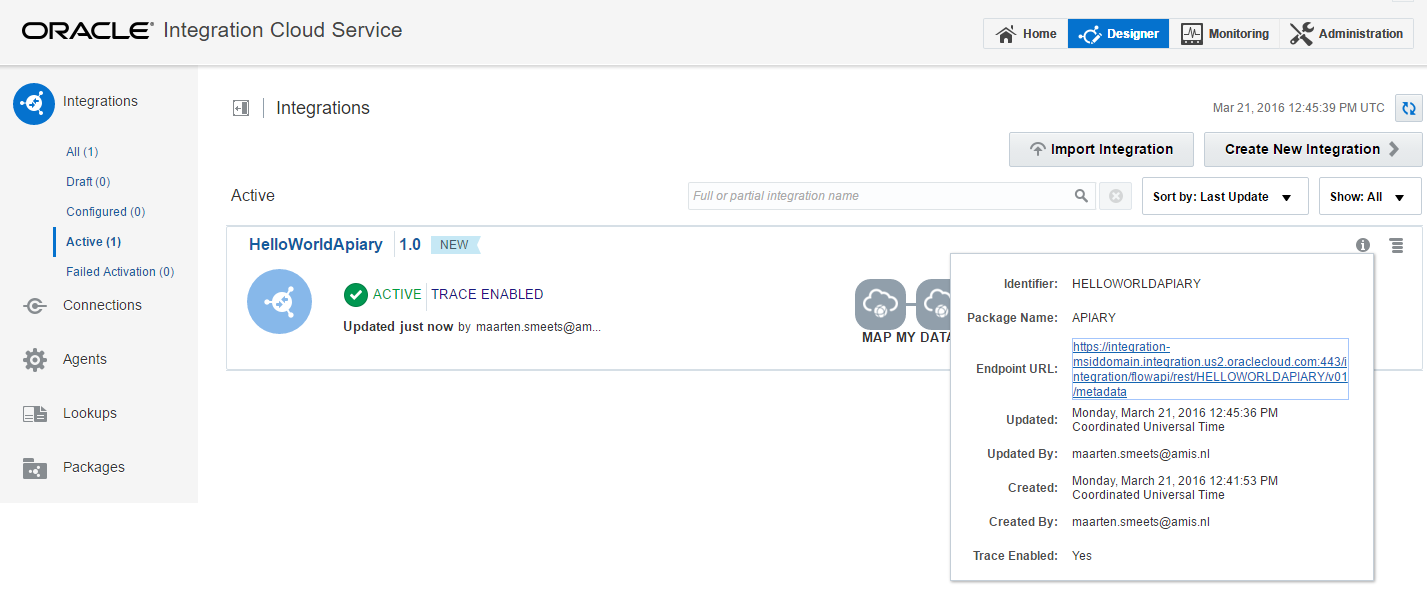
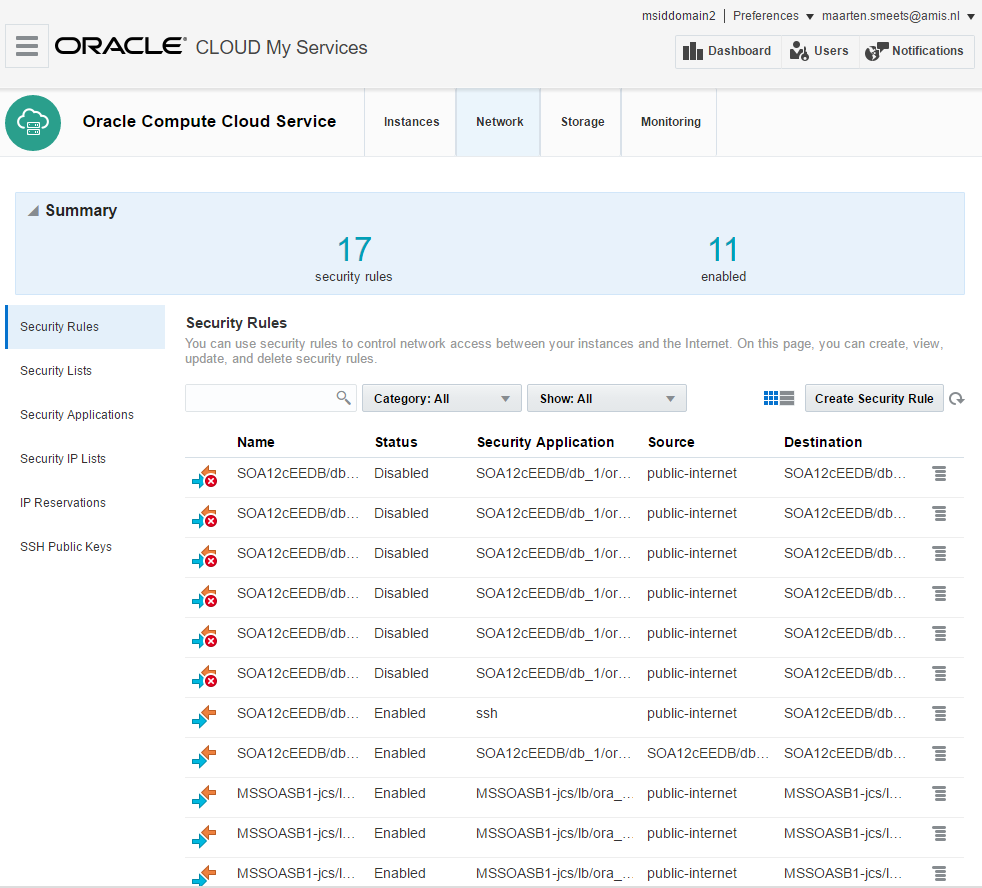
I experimented with ICS on two use-cases. I wanted to proxy SOAP and REST requests. For the SOAP request I used a SOA-CS Helloworld web-service and for the REST request I used an Apiary mockservice. I will not go into basics too much such as creating a new Connection and using the Connection in an Integration since you can easily learn about those in other places.

ICS: Calling a SOAP service on SOA-CS

When you want to call a SOAP service which you have exposed on ICS, you require two sets of headers. The WS-Timestamp headers and the WSS-UserName token headers (with the password in plain text).

This is required even when you have not specified a security policy (currently username/password token and basic authentication are supported). When you don’t provide them, you get Service Bus errors (as shown in the screenshot below) which indicates ICS is running on the Service Bus (in case you didn’t know this yet, it is no secret). This was not required when directly calling the SOA-CS service. Read the complete article here.

SOA & BPM Partner Community

For regular information on Oracle SOA Suite become a member in the SOA & BPM Partner Community for registration please visit www.oracle.com/goto/emea/soa (OPN account required) If you need support with your account please contact the Oracle Partner Business Center.

Blog Twitter LinkedIn image[7][2][2][2] Facebook clip_image002[8][4][2][2][2] Wiki