BPEL-> Mediator -> BPEL: Passing Business Errors back thru Mediator by Niall Commiskey


clip_image002Scenario:

Sync BPEL1 calls Mediator that calls Sync BPEL2.

SyncBPEL2 throws a Business Error, Mediator needs to pass this back to SyncBPEL1.

In the following example I have the following components –

Sync BPEL 1 = BPELProcess3

Mediator = Route2BPEL1

Sync BPEL 2 = ErrorThrower

Here they are, in all their grandeur –

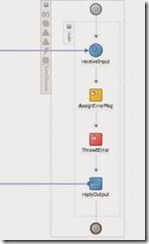
ErrorThrower

Note the explicit definition of the fault in the wsdl –

Read the complete article here.

SOA & BPM Partner Community

For regular information on Oracle SOA Suite become a member in the SOA & BPM Partner Community for registration please visit www.oracle.com/goto/emea/soa (OPN account required) If you need support with your account please contact the Oracle Partner Business Center.

Blog Twitter LinkedIn image[7][2][2][2] Facebook clip_image002[8][4][2][2][2] Wiki

OSB Release Management Utility by Joao Moura


clip_image002Agile methodologies have increased radically the numbers of release events in organisations where it has been adopted.  Both development and operations teams need to collaborate more closely during production release events requiring more than ever the right supporting tools.

How many times have you been asked what has been deployed in environment X?

If you are using CI tools and doing release management properly it should be a straightforward answer. However, software deployment comprises a set of steps involving multiple parties. As a result, the process isn’t entirely automated requiring human intervention which is susceptible to errors.

Imagine you have just delivered an OSB Production bundle to the operations guys (DBAs, Weblogic Admins…).

How can you prove that the expected jar has been deployed without looking at the source code or running any tests ?

We are using a custom Release Management Utility that saves us a lot of time and headaches ☺

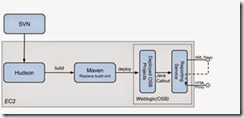
· No third-party software required; It uses Hudson, SVN, Maven and OSB

· Allows users without technical knowledge to view what’s deployed

· Identifies project changes between sprints

· Track back to source code based on SVN revision

· Displays build date and version for each individual project

Read the complete article here.

SOA & BPM Partner Community

For regular information on Oracle SOA Suite become a member in the SOA & BPM Partner Community for registration please visit www.oracle.com/goto/emea/soa (OPN account required) If you need support with your account please contact the Oracle Partner Business Center.

Blog Twitter LinkedIn image[7][2][2][2] Facebook clip_image002[8][4][2][2][2] Wiki

espresseo & integration – Opitz events 01.10 Frankfurt, 29.10 München & 25.11 Hamburg

Beginnen Sie den Tag mit einem tollen Frühstück sowie leckeren Kaffeespezialitäten und erfahren Sie bei unserem IT|espresso mehr zum Thema "Systemintegration". Unter der Fragestellung "Wie wird meine Integrationslandschaft modern, nutzbringend, wartbar und preiswert", möchten wir mit Ihnen und anderen Experten in lockerer Atmosphäre über Erfolgsfaktoren sowie Trends und deren Implikationen z.B. wie man eine Cloud Application integriert, diskutieren. Nutzen Sie die Chance zum Gedanken- und Erfahrungsaustausch mit unseren Experten Torsten Winterberg und Dr. Hendrik Voigt sowie den anderen Teilnehmern und gestalten Sie die Agenda mit Ihren aktuellen Themen.
Seien Sie dabei:  01.10. Frankfurt, 29.10. München, 25.11. Hamburg

Weitere Details zur Veranstaltungsreihe

SOA & BPM Partner Community

For regular information on Oracle SOA Suite become a member in the SOA & BPM Partner Community for registration please visit www.oracle.com/goto/emea/soa (OPN account required) If you need support with your account please contact the Oracle Partner Business Center.

Blog Twitter LinkedIn image[7][2][2][2] Facebook clip_image002[8][4][2][2][2] Wiki

Searching Service Bus Pipeline Alert contents by Maarten Smeets


clip_image001There are several ways monitor messages passing through the Service Bus. Using pipeline alerts is one of them. Pipeline alerts can be searched in the Enterprise Manager based on several parameters such as summary or when they have occurred. Usually an important part of the message payload is saved in the content of the alert. This content can not be searched from the Enterprise Manager. In this post I will provide an example for logging Service Bus request and response messages using pipeline alerts and a means to search alert contents for a specific occurrence. The example provided has been created in SOA Suite 12.1.3 but the script also works in SOA Suite 11.1.1.6.
Service Bus Pipeline Alerts

The Oracle Service Bus provides several monitoring mechanisms. These can be tweaked in the Enterprise Manager.

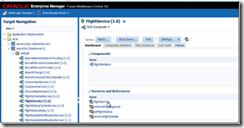
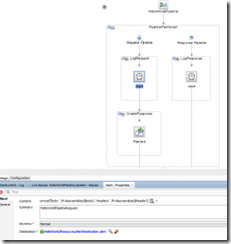
In this example I’m going to use Pipeline Alerts. Where you can find them in the Enterprise Manager has been described on: https://technology.amis.nl/2014/06/27/soa-suite-12c-where-to-find-service-bus-pipeline-alerts-in-enterprise-manager-fusion-middleware-control/. I’ve created a small sample process called HelloWorld. This process can be called with a name and returns ‘Hello name’ as a response. The process itself has a single AlertDestination and has two pipeline alerts. One for the request and one for the response. These pipeline alerts write the content of the header en body variables to the content field of the alert.

When I call this service with ‘Maarten’ and with ‘John’, I can see the created pipeline alerts in the Enterprise Manager. Read the complete article here.

SOA & BPM Partner Community

For regular information on Oracle SOA Suite become a member in the SOA & BPM Partner Community for registration please visit www.oracle.com/goto/emea/soa (OPN account required) If you need support with your account please contact the Oracle Partner Business Center.

Blog Twitter LinkedIn image[7][2][2][2] Facebook clip_image002[8][4][2][2][2] Wiki

Docker image for Oracle SOA Suite 12c by Jorge Esteban Quilcate Otoya

clip_image002

Cool news came from Oracle a couple of weeks ago: Oracle WebLogic Server is now supported on Docker!.

This is very cool. Docker is a disruptive platform that ship everything inside a container (OS, Configurations, Platform, Application) and let you run it (almost) everywhere! To learn more about Docker

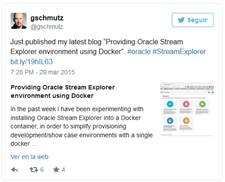
So, WebLogic on Docker is great, but I’d like to go further and Dockerize SOA and BPM products (as Guido Schmitz made with Oracle Stream Explorer)

I used Oracle’s Docker repository as a base to create a Oracle SOA Suite 12c image (with the product installed – no domain included), and a sample Docker configuration to create a Docker image with a domain with SOA and OSB.

Get the repository

To try this post you should have a machine with Docker installed.

To get started you can download the repository: http://github.com/jeqo/oracle-docker

The repository includes images for MySQL, WebLogic and Coherence. These images comes from Oracle repository.

My contribution is into the ‘OracleSOA’ directory.

Feel free to fork and create "pull-requests"!

Creating the SOA Suite 12c image

Now you should download Oracle SOA Suite 12c Quick Start installer, and put it into OracleSOA/dockerfiles/12.1.3. Also, you should download Java Development Kit 7, and put it in the same folder.

Open a terminal into OracleSOA directory, go to dockerfiles, run the script buildDockerImage.sh with the -d argument because we are installing the Quick Start version of SOA Suite 12c: Read the complete article here.

SOA & BPM Partner Community

For regular information on Oracle SOA Suite become a member in the SOA & BPM Partner Community for registration please visit www.oracle.com/goto/emea/soa (OPN account required) If you need support with your account please contact the Oracle Partner Business Center.

Blog Twitter LinkedIn image[7][2][2][2] Facebook clip_image002[8][4][2][2][2] Wiki

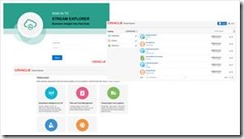
A First Glance at Oracle Stream Explorer 12c by Arturo Viveros


clip_image002The brand new Oracle Stream Explorer 12c has been released today. The idea behind this product, which gives it a lot of relevance, is to bring simplicity, usability and enterprise readiness to Event Processing.
We have talked before about Industrial SOA, and the impact that such concepts as: IoT, Social Media, Mobile, Fast Data bring to the table. With this in mind, we have to acknowledge that enterprises nowadays, constantly find themselves dealing with huge, endless amounts of data in motion.
Oracle’s pitch in this sense, with Oracle SX, is to put this Real Time Streaming Intelligence in the hands of Business Users and Integrators, who can instantly determine the business value of the information and its relevance as business opportunities and threats.
So let’s take a look at the product istself:

As you can see, Oracle SX looks really cool!!, and the first thing we must say in this regard, is that the product’s user interface has been entirely built using Alta UI. Hence we are practically guaranteed a very favorable user experience which is not only nice, but will also help us position the tool in our clients.
Functionality-wise, SX abstracts event processing capabilities to a degree in which the user requires no knowledge whatsoever of Real Time Event Driven Architectures, Continuous Query Language (CQL), Java Event Server or the semantics of Event Stream Processing Application Models.
Basically, Stream Explorer introduces three main concepts that we must understand in order to configure the scenarios we want: Read the complete article here.

SOA & BPM Partner Community

For regular information on Oracle SOA Suite become a member in the SOA & BPM Partner Community for registration please visit www.oracle.com/goto/emea/soa (OPN account required) If you need support with your account please contact the Oracle Partner Business Center.

Blog Twitter LinkedIn image[7][2][2][2] Facebook clip_image002[8][4][2][2][2] Wiki

SOA Suite 12c – Create, Deploy, Attach and Configure a Custom OWSM Policy – to report on service execution by Lucas Jellema


clip_image002This article describes how to develop a straightforward custom assertion that can be used as part of custom OWSM policy to be attached to Web Services in WebLogic, such as services exposed by SOA Composite applications and Service Bus projects as well as custom JAX-WS or ADF BC Web Services. The custom assertion that I demonstrate here reports the execution of web service operations to a JMS Destination and/or the system output. It shows how to access property values set on the policy binding (values specific for the service the policy is attached to) and how to inspect the headers and contents of the request and response messages. Most custom assertions will use a subset of the mechanisms shown in this example. As always, the source code is available for download. Note: this article was edited on April 6th to reflect better code structure.

Custom assertions can be used in policies that are applied to web services. Depending on the type and configuration of the policy and assertions, they can be triggered at different moments and perform different tasks. These assertions are similar to aspects (in AOP) that take care of cross cutting concerns and that do not interfere with the internals of a service. Policies are attached (and detached) at runtime by the administrators. The assertion discussed in this article is to be attached to the service binding at the inbound end of a SOA composite application (or at a Service Bus proxy service that serves the same purpose). The assertion will report every incoming request as well as each response returned from the service binding. This information can be leveraged outside the scope of this article to monitor the runtime service environment.

The steps describes in this article in the process of creating and putting into action the custom assertion are:

  • Create Custom Policy:
    • Assertion Java Class
    • Policy XML File
    • Policy Configuration XML File
  • Deploy Policy Artifacts to Runtime Fusion Middleware platform (and restart the WebLogic Servers)
  • Import Policy Definition into Runtime Fusion Middleware platform
  • Attach the Policy to a Service Binding in an existing SOA Composite application and configure the policy binding properties
  • Invoke the service exposed by the [Service Binding in the existing] SOA Composite application
  • Verify the results produced by the policy attachment
Create the Custom Policy

The main part of the custom assertion definition is a Java class. See for details the sources that can be downloaded from GitHub.The project contains a helper class – CustomAssertion – that takes care of some generic plumbing that are required for the AssertionExecutor superclass that needs to be extended. Read the complete article here.

SOA & BPM Partner Community

For regular information on Oracle SOA Suite become a member in the SOA & BPM Partner Community for registration please visit www.oracle.com/goto/emea/soa (OPN account required) If you need support with your account please contact the Oracle Partner Business Center.

Blog Twitter LinkedIn image[7][2][2][2] Facebook clip_image002[8][4][2][2][2] Wiki

What is the Power of Cloud? (to the Business) By Dave Berry


Of course many readers, technologists and businesses are acutely aware of the value prop of the cloud but what about the rest of the "majority" of people who don’t? If you do a search on this topic, you will mostly get links to marketing materials that are fairly high level and full of the usual buzzwords with more links to lengthy case studies. As a business technology enabler, there needs to be a simpler message or elevator pitch that is easy to understand yet convincing. Ah, the simplicity or less is more approach rears it’s beautiful head once again. Below are some recipes to draw from for an elevator ride of any duration.

The Enterprise Cloud Reduces Business Outages Increasing Customer Satisfaction

Put simply and avoiding technical acronyms, can the business rely on 99.99+% availability from the cloud? Look no further than Netflix as an example because yes the cloud is certainly up to the task.

Immediate Availability Gives You a Your Competitive Edge (for now)

Back in the day, Dell drove industry change by assembling computers on demand reducing inventories and wrecking havoc on computer storefronts. Well the cloud equivalent is to be able to go to the cloud store, answer a few questions, enter your credit info and within 1 hour or less you are up and running.

A Right Sized Business Reduces Time, Headaches and Cost

You may wonder what this is? It takes many forms but to me you have to ask does the business get what it paid for? No more shelf ware and complicated upgrade processes. You need more capacity for certain business cycles, zoom it’s there. You need more storage, of course that is automated. You think Apple and other retailers have to turn on any switches to increase capacity? Maybe they do now but they shouldn’t.

Business Friendly User Interfaces Decreases Time to Market

Your thinking mobile and that is certainly true but it is much more than that. This is the type of disruptive technology that could put technologists like me out of work. Non-technical end users must be able to build and deploy apps that previously required a CS degree and many years of experience. Consider how Smart Data cloud initiatives are disrupting Big Data. Nate Silver, beware.

Build a Nimble Business by Thinking Small

The cloud is all about modularity, extensibility and continuous release cycles. A/B testing drives micro feature planning rendering the traditional roadmap virtually useless. In a fully optimized environment, features will show up before you even have a chance to request them. Social tools will drive this change more than traditional communication channels and you have to be on top of it because your competition sure is. Read the complete article here.

SOA & BPM Partner Community

For regular information on Oracle SOA Suite become a member in the SOA & BPM Partner Community for registration please visit www.oracle.com/goto/emea/soa (OPN account required) If you need support with your account please contact the Oracle Partner Business Center.

Blog Twitter LinkedIn image[7][2][2][2] Facebook clip_image002[8][4][2][2][2] Wiki

Managed File Transfer (MFT) free hands-on workshops September USA

Oracle Managed File Transfer (Oracle MFT) enables secure file exchange and management with internal departments and external partners. It protects against inadvertent access to unsecured files at every step in the end-to-end transfer of files. It is easy to use especially for non technical staff so you can leverage more resources to manage the transfer of files. The built in extensive reporting capabilities allow you to get quick status of a file transfer and resubmit it as required.

This FREE hands-on workshop covers all the capabilities you need to build robust, reliable and agile managed file transfers.

Sept 10th &11th at Redwood Shores, CA

Sept 17th  and 18th  at Reston, VA

clip_image002

SOA & BPM Partner Community

For regular information on Oracle SOA Suite become a member in the SOA & BPM Partner Community for registration please visit www.oracle.com/goto/emea/soa (OPN account required) If you need support with your account please contact the Oracle Partner Business Center.

Blog Twitter LinkedIn image[7][2][2][2] Facebook clip_image002[8][4][2][2][2] Wiki

Fusion HCM Integration by Kiran Mundy


clip_image002Because of frequent questions from HCM customers on how they can use BPEL to integrate with Fusion HCM, I’ve put together the details here

Your orchestration layer is the software [such as Oracle’s SOA BPEL or BPM Studio] you currently already use, to wire together Fusion HCM Loader/Extract programs to other apps.

SOA/BPEL
Companies already using SOA/BPEL can just add Fusion HCM into the mix.
Steps to accomplish this are below:.

INBOUND TO FUSION HCM

  1. BPEL’s "File Adapter" to read the data in.
  2. BPEL’s Transform Activity with Domain Value Maps to transform the data.
  3. You need to get the UCM Service exposed externally (In Rel10 it will be exposed, but on Rel9, you’ll need to do the following):
    1. File an SR requesting Fusion HCM to perform a Key Exchange – Aside from allowing you to send "encrypted" files into Fusion, this step will also result in the UCM Service being exposed externally.
      • Ensure you file the SR under Oracle Cloud Global Human Resources Cloud Service.
      • Choose Hosting Services – Application -> Encryption Key Exchange
  4. Use BPEL to Invoke the UCM Soap Service to write the File into UCM.
  1. Invoke the HCM Loader Programs passing them the encryption parameter along with other required parameters.
    • FBL wsdl is the following form: https:// <Hostname>/LoaderIntegrationService?WSDL
    • HDL wsdl is the following form: https:// <Hostname>/hcmCommonDataLoader/HCMDataLoader?wsdl
  2. Find out which user privileges you must assign to the users who call these web services in OER: https://fusionappsoer.oracle.com
  3. Sample Payloads for the above services are available here. [You can enter comments into the sample payloads doc if you find any issues].
  4. Later when REST Services are available (Release 9 Patch Bundle 6 under "controlled availability" most likely), for your lighter weight inbound integrations, such as Fusion/Taleo, you will have the option to switch #3/4/5 to a REST service call to create/update the employee in Fusion. NOTE: Cco-existence scenarios should continue to use batch loaders because:
    • Performance Reasons – services won’t perform as well under heavy loads
    • The breadth of data needed for co-existence isn’t covered (or intended to be covered) by the REST Services.

OUTBOUND FROM FUSION HCM Read the complete article here

SOA & BPM Partner Community

For regular information on Oracle SOA Suite become a member in the SOA & BPM Partner Community for registration please visit www.oracle.com/goto/emea/soa (OPN account required) If you need support with your account please contact the Oracle Partner Business Center.

Blog Twitter LinkedIn image[7][2][2][2] Facebook clip_image002[8][4][2][2][2] Wiki