Message Aggregation in Oracle SOA Suite 12c by Jennie DeRosa


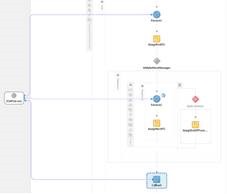
clip_image002Within the Oracle SOA Suite, message aggregation is a concept that allows for multiple messages to be routed to the same BPEL process, based on a value(s) defined within the incoming payload. This is implemented within BPEL through the use of correlation sets.

To implement this, a correlation set is defined and will contain one or more properties. These properties have aliases to values within the input payload message (i.e. PurchaseOrderNumber), which are used for the correlation of messages.

Oracle SOA Suite 12c has provided a wizard that allows for easy definition of the correlation set, properties and property aliases which are all necessary for correlation to occur. Below are the steps required to configure your BPEL process to perform message aggregation via correlation set.

Configuration Steps

The first step is to create the Correlation Set. Right click on the initial receive of the process and select ‘Setup Correlation…’ Read the complete article here.

SOA & BPM Partner Community

For regular information on Oracle SOA Suite become a member in the SOA & BPM Partner Community for registration please visit www.oracle.com/goto/emea/soa (OPN account required) If you need support with your account please contact the Oracle Partner Business Center.

Blog Twitter LinkedIn image[7][2][2][2] Facebook clip_image002[8][4][2][2][2] Wiki

SOA Suite 12c: Multithreaded instance purging with the Java API by Maarten Smeets


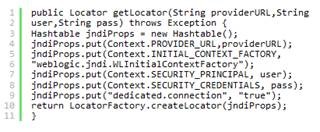
clip_image002Let’s tackle a single topic at a time in this blog post SOA Suite 12c provides a Java API to perform operations on the SOA infrastructure and things running there such as composites and instances. There are several blog posts available on how to do this in SOA Suite 10g and 11g. However since 12c is relatively new, I decided to try if I could easily access the Java API in 12c and if the API was still similar to 11g or had undergone major changes. As a usecase I decided I wanted to purge instances. This is usually done by database scripts on the SOA infra database. If however you do not have direct access to the database, this can be used as an alternative. I could of course have done the same by using WLST. I found that purging instances by using the Java API was slow so I decided I would like to try this using multiple threads working in parallel. The resulting code is provided in this post.

Implementation

In order to separate the different topics which will be discussed in this blog post I split the implementation in three parts. JDeveloper 12c, Purging composites and Multithreading.

JDeveloper 12c. Using the SOA Suite Java API

In JDeveloper 11g I would have to add the required libraries in the project properties and I could create a Java class which could access the Java API. In JDeveloper 11g I would have to add the following library references: WebLogic 10.3 Remote-Client, SOA Runtime, JRF API. I decided to try the same in JDeveloper 12c. When adding the SOA Runtime however, JDeveloper 12c decided I would want to develop a composite and ‘refactored’ my project to allow development of composites. This wasn’t what I wanted however. In order to avoid this issue/feature I decided to add a single JAR to my 12c project containing required classes instead of using the SOA Runtime library reference. I added oracle.soa.wlstman.jar from my ORACLE_HOME/soa/soa/oracle.soa.fabric.11.1.1 folder (yes, the 11.1.1 folder is still there in 12.1.3). I of course also needed to add Weblogic 12.1 Remote-Client and JRF API to get it working. I have not tried manually editing the pom.xml to include the SOA Runtime dependency, so I can not say if this will avoid the project refactoring done by JDeveloper. Read the complete article here.

SOA & BPM Partner Community

For regular information on Oracle SOA Suite become a member in the SOA & BPM Partner Community for registration please visit www.oracle.com/goto/emea/soa (OPN account required) If you need support with your account please contact the Oracle Partner Business Center.

Blog Twitter LinkedIn image[7][2][2][2] Facebook clip_image002[8][4][2][2][2] Wiki

SOA Suite 12c: In-depth look into Managed File Transfer (1/3) by Robert van Molken

clip_image002

With the release of SOA Suite 12c a new product was revealed. The first sighting was at Oracle OpenWorld 2013. On the Fusion Middleware Demo Grounds there was a demo shown where B2B was integrated with a product called Managed File Transfer (shortened as MFT). At that same conference I gave a presentation about this product together with the product manager of MFT, Dave Berry. This blog gives an in-depth look into Managed File Transfer.

There is a growing problem with FTP in the enterprise where there is a lack of control, visibility, security and reliability. The lack of control is due to the uncontrolled proliferation of FTP servers & clients. Departments are creating stand-alone FTP servers and configuring users where needed. There is no central FTP server. Because of this there is no global visibility of the exchange of crucial data files – including customer data. It is highly possible that these FTP servers are not integrated with enterprise security standards where as FTP servers are rarely integrated with directories. Because these FTP servers run stand-alone they are a single point of failure and rarely offer HA capabilities, which effects the reliability. This can be tackled using Managed File Transfer.

Lack of control, visibility, security & reliability

What is Managed File Transfer?

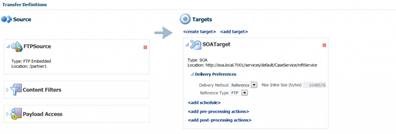
MFT is a simple and secure End-to-End Managed File Gateway. At the base MFT uses an “Embedded” (S)FTP / SSH server which support HA clustering. MFT has a scalable architecture, which mean it can easily be expanded by adding another Weblogic node to the cluster.  It also includes an extensible framwork for pre/post processing of files. MFT integrates with Standards Based Middleware like (S)FTP, SOA, B2B, Service Bus and Web Services. Read the complete article here.

SOA & BPM Partner Community

For regular information on Oracle SOA Suite become a member in the SOA & BPM Partner Community for registration please visit www.oracle.com/goto/emea/soa (OPN account required) If you need support with your account please contact the Oracle Partner Business Center.

Blog Twitter LinkedIn image[7][2][2][2] Facebook clip_image002[8][4][2][2][2] Wiki

Integration Cloud Service (ICS) is available

clip_image002Oracle Integration Cloud Service (ICS) is available.

ICS Partner quotes

  • “Easy integration of enterprise systems!” Jacco Cijsouw, Amis
  • “Take integration to a new level!” Rob de Haan, RedBlue
  • “Fantastic encapsulation of complex integration problems within a Business friendly tool” Daniel Alves, eProseed
  • “A game changer for enterprise cloud integration” André Evensen, Acando
  • “IPaaS will become more important. With ICS now Oracle enter this market and provide the possibility to integrate applications on a stable infrastructure basis in the Cloud” Marcel Mertin, ec4u
  • “Going to discover what is in the cloud – use Oracle ICS” Andreas Chatziantoniou, Foxglove IT
  • “Pay what you use and be able to scale” Gerald Reif, IPT
  • “You know Oracle’s on to something, when building the integration in the cloud is just as user friendly and fast as using the cloud applications we’re tying together.” Jan Van Hoef, Contribute
  • “Make your cloud come to life.” Mario Sosic, The Future Group
  • “With ICS and rest of cloud services, Oracle is now fully committed to penetrate the iPaaS market that has been until date dominated by Dell Boomi’s, Mulesoft’s and the like. However Oracle we are positive that with all the cloud services Oracle will have the most comprehensive suite of cloud services in the market” Luis Weir HCL & Arturo Viveros S&P Solutions
  • “Cloud will be the THING this year and Oracle is taking the right direction with creating the Integration, Process, Mobile, Java and Developer Cloud Services. It has a slick UI design and it works responsive.” Robert van Mölken, Amis

ICS demo system: We are in process to make the PaaS Services available via GSE. Please make sure that you request our GSE access here. SOA Specialized Partners and member of the SOA & BPM Partner Community can access ICS demo viewlets here.

ICS presentation, whitepaper, video, datasheet & marketing kit At our SOA Community Workspace (SOA Community membership required) we posted

ICS ppt presentation

ICS click demo

ICS video

ICS white paper-use-cases

ICS data sheet

ICS marketing kit

ICS Partners: Looking for a SOA Specialized Partner which can support you with your ICS implementation? Visit the solutions catalog here, and search for your local SOA Specialized partner have trained & certified consultants and implemented successful SOA customer projects. Across EMEA more than 1000 companies are Specialized in SOA! Find local Specialized partners by product www.oracle.com/specialized & learn more about ICS here

SOA & BPM Partner Community

For regular information on Oracle SOA Suite become a member in the SOA & BPM Partner Community for registration please visit www.oracle.com/goto/emea/soa (OPN account required) If you need support with your account please contact the Oracle Partner Business Center.

Blog Twitter LinkedIn image[7][2][2][2] Facebook clip_image002[8][4][2][2][2] Wiki

SOA Suite 12c: The Coherence Adapter By Maarten Smeets


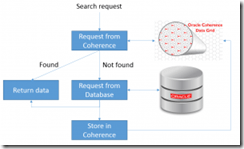
clip_image001Oracle SOA Suite 12c ships with a new technology adapter, the Oracle CoherenceAdapter. This adapter allows easy integration with a Coherence Data Grid (a distributed cache). The excellent post by Antony Reynolds provides the information required to setup your Coherence cache and get started with the adapter. In this blog post I will describe a pattern which can be used to use Coherence Data Grid as a cache for a database table (or view, or…). Also I did some performance measures on the Oracle quickstart JDeveloper installation with Integrated Weblogic server and an XE database with surprising results!

Important tips from Antony’s post:

  • Use one Coherence cache per object type. This allows clearing the entire cache and specifying specific behavior per object type.
  • Make sure the Coherence configuration file is available to every server in the cluster (shared storage). This is similar to a DbAdapter configuration plan.
  • Set the servicename in the outbound connectionFactory of the CoherenceAdapter to DistributedCache so it works in clusters and WLSExtendProxy to false unless you are using this feature.
  • In 11c you can use Coherence from within a SOA Suite Spring component or by enabling the OSB result cache. Both have disadvantages though. 12c provides the CoherenceAdapter as alternative. Read the complete article here.

SOA & BPM Partner Community

For regular information on Oracle SOA Suite become a member in the SOA & BPM Partner Community for registration please visit www.oracle.com/goto/emea/soa (OPN account required) If you need support with your account please contact the Oracle Partner Business Center.

Blog Twitter LinkedIn image[7][2][2][2] Facebook clip_image002[8][4][2][2][2] Wiki

Five Tools for Debugging Oracle SOA Suite by Adam Mead


clip_image001Have you ever completed a software project and had nothing go wrong? Neither have I. Projects using Oracle’s SOA Suite are no different than Java projects and you will need to debug issues at some point.

Here are five tools for debugging issues on Oracle SOA Suite:

1. Flow Trace and Audit Trail

If you have an issue with a specific instance, or instances that follow a specific path, both the flow trace of the composite instance and audit trail of the component instances are extremely helpful. Flow traces and audit trails help you pinpoint a location to look in your code. You can look at the location of the error and step back through the flow trace and audit trail from that point to trace back to the cause of the issue.

In most production systems, the domain audit level will be set to Production so the system doesn’t write too many audit records. When the audit level is set to production, you won’t be able to see the payload in mediators or assignment activities – two places likely to have mistakes. The audit level can be changed on each composite individually, so if your domain audit level is set to Production, you can always temporarily change the audit level of your problem composite to Development to help troubleshoot an issue. However, changing the audit level will only have an effect on activities completed after the changes is made.

To change the audit level on a composite:

1. Navigate to Enterprise Manager in a browser

2. In the left panel expand SOA, then soa-infra, then the partition to which your project is deployed, then click on your composite

3. In the main panel, click on Settings… -> Composite Audit Level: Inherit -> Development Read the complete article here.

SOA & BPM Partner Community

For regular information on Oracle SOA Suite become a member in the SOA & BPM Partner Community for registration please visit www.oracle.com/goto/emea/soa (OPN account required) If you need support with your account please contact the Oracle Partner Business Center.

Blog Twitter LinkedIn image[7][2][2][2] Facebook clip_image002[8][4][2][2][2] Wiki

Mobile Suite Service Bus REST and ADF BC SOAP by Andrejus Baranovskis

clip_image002One of the key parts of Oracle Mobile Suite 12c offering is Service Bus product. This is logical choice – Service Bus allows to transform complex SOAP Web Service data into simplified REST format, preferred by mobile client. I think it is essential to use Service Bus, when implementing enterprise mobile applications. It makes sense to learn how Oracle Service Bus works. I would recommend to start from Steven Davelaar excellent tutorial article, available here – Creating a Mobile-Optimized REST API Using Oracle Service Bus – Part 2.
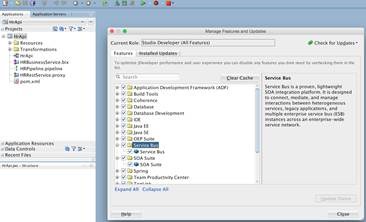
I have created my own ADF BC application with SOAP WS – findEmployees method (filters by first and last name). Here you can download both applications – MobileServiceBusApp_v1.zip. Keep in mind, for some reason Service Bus server doesn’t start with JDEV 12c BPM Default Domain, it works only with JDEV 12c SOA Default Domain. Make sure to check, which JDEV you are using, you can check the list features installed: ADF BC SOAP service is implemented to support Master-Detail (Employee – Department Managed by Employee) structure: Read the complete article here.

SOA & BPM Partner Community

For regular information on Oracle SOA Suite become a member in the SOA & BPM Partner Community for registration please visit www.oracle.com/goto/emea/soa (OPN account required) If you need support with your account please contact the Oracle Partner Business Center.

Blog Twitter LinkedIn image[7][2][2][2] Facebook clip_image002[8][4][2][2][2] Wiki

Podcast Show Notes: Microservices Roundtable by OTN


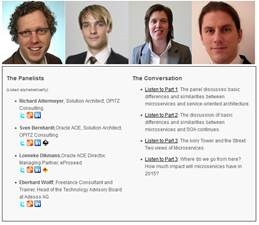
clip_image002Microservices. Big deal? No deal? For more than a year the conversation about microservices has been percolating — and on occasion boiling over. This new series of OTN ArchBeat Podcast programs jumps into that conversation with a panel of community members who have skin in game, and well-reasoned opinions on the potential impact microservices will have on enterprise IT.

Listen to the podcast here.

SOA & BPM Partner Community

For regular information on Oracle SOA Suite become a member in the SOA & BPM Partner Community for registration please visit www.oracle.com/goto/emea/soa (OPN account required) If you need support with your account please contact the Oracle Partner Business Center.

Blog Twitter LinkedIn image[7][2][2][2] Facebook clip_image002[8][4][2][2][2] Wiki

Test-driven development using the Oracle SOA Suite by The Cattle Crew


clip_image001As in all software projects, quality assurance with thorough testing in integration projects is a key factor to success. Test-driven development focuses exactly on this aspect: unit and integration testing of integration elements must be done as soon as possible. The tests used in these phases must also be reproducible so that they can be run automatically in case of changes in the integration logic, thus guaranteeing that no unintended changes are made.

Oracle SOA/BPM Suite is a powerful tool suite for integration. This article shows how test-driven development can be done with the Oracle tooling. Integration elements built with Oracle SOA/BPM Suite are SCA composites made up of several components. Since mainly the integration layer is concerned, there is quite often heavy usage of external web services, database adapters, etc. The composites also usually have an inbound interface the invocation of which is the starting point of the integration logic.

As it can be seen from above, the key to testing SCA composites is to define an inbound message and assert the data found in various other messages during the integration logic. Some easy scenarios can instantly be identified. XSLT transformations within the composites can be unit-tested without the complete logic itself for example. Likewise, end2end testing is also easily done – at least for a web service interface – thus assuring at least that the result is what we expected. The problem is that for end2end testing, the correct functionality of back-end systems is a prerequisite. If the back-end functionality is developed parallel to the integration logic, end2end testing is far away from test-driven development. Read the complete article here.

SOA & BPM Partner Community

For regular information on Oracle SOA Suite become a member in the SOA & BPM Partner Community for registration please visit www.oracle.com/goto/emea/soa (OPN account required) If you need support with your account please contact the Oracle Partner Business Center.

Blog Twitter LinkedIn image[7][2][2][2] Facebook clip_image002[8][4][2][2][2] Wiki

eProseed has accomplished it’s first go-live with SOA Suite 12c technology

clip_image001We are pleased to announce that eProseed has accomplished its first go-live with 12c technology working with CFL – The Luxembourgish National Railway Company.
With this implementation, CFL accomplished a high-reliable, agile and flexible integration platform across various heterogeneous application – existent in and off-premises – empowering CFL monitoring and control capabilities in addition to a faster customer on-boarding.
eProseed team’s expertise enhanced the new SOA Suite 12c capabilities enabling to deliver a short time-to-market solution based in standards and best practices that lays a solid foundation for future coming projects.
This first phase is cornerstone of a broader IT transformational project where CFL wants to put in place a full SOA platform capable of handling all the communications between its internal applications and their partners.
The synergies between the SOA 12c components, namely B2B and OSB products, are key for building a solid and flexible integration layer to implement a variety of interfaces that enable CFL to communicate easily and efficiently with all of their partners. Read the article here.

SOA & BPM Partner Community

For regular information on Oracle SOA Suite become a member in the SOA & BPM Partner Community for registration please visit www.oracle.com/goto/emea/soa (OPN account required) If you need support with your account please contact the Oracle Partner Business Center.

Blog Twitter LinkedIn image[7][2][2][2] Facebook clip_image002[8][4][2][2][2] Wiki