Emerging Tech and the Enterprise

clip_image002:Wearables — your Apple Watches, Fitbits, and Misfits — are finally coming out to play in the world of enterprise applications. The Internet of Things (IoT) is also changing the game, so adopting a smart strategy is key. If you haven’t yet, check out this post on the Voice of User Experience (VoX) blog, “Wearables, IoT push Oracle’s emerging tech development.”

Enterprise use cases can be hard to come by for some technologies, such as voice and gesture as input, but Oracle needs to keep up with the latest developments in those fields anyway so that we’re ready when an enterprise use case comes up. Another post on VoX, “New ways of input still on the verge of the enterprise,” explains how we’re doing that.

Interested in how we research, design, and develop for these emerging technologies? We’ve got three new emerging tech articles that describe the challenges and provide insight into how the Oracle Applications User Experience (OAUX) team gets it done. For a look at how this technology influences Oracle’s cloud user experience strategy, head to this recently updated article from Jake Kuramoto, director of the AppsLab, the OAUX Emerging Technologies team.

PLATFORM FOR JEREMY ASHLEY: The OAUX Group Vice President has two new pages live on Oracle.com. You will find him among Oracle’s Thought Leaders, and he’s also listed as a corporate spokesperson for North America.

This is part of an ongoing effort to give Ashley a platform as a Thought Leader at Oracle. Since mid-2015, he’s been publishing on a variety of topics related to user experience and design on Forbes.com. He’s been speaking at events around the globe, and a new push is being made to capture the recognition his team deserves for their hard work on the Cloud user experience. Jeremy’s Thought Leader page contains several links to recent key posts on Forbes.com, links to Jeremy’s LinkedIn profile and Twitter feed, videos in which he shares his perspective on innovation and user experience, and links to the Usable Apps website and the VoX blog, where you can find posts and articles from many members of the OAUX team on projects you’ve all had a hand in.


CUSTOMER CONNECT WEBINARS:
The OAUX team has several new webcasts to share. Please take a look. You must be a member to view the webcasts.

· Winning with User Experience in CPQ Cloud, by Shirin Lange and William Gobber, Oracle

· Oracle Applications User Experience – Emerging Technologies, Building Tomorrow’s Experiences, by Jake Kuramoto, The AppsLab, OAUX

· Oracle’s Investment in Cloud Application’s User Experience, by Julian Orr, OAUX, and Basheer Khan, Knex Technologies

· Cloud UX Rapid Development Kit (RDK), with Julian Orr and Karen Scipi, OAUX

SOA & BPM Partner Community

For regular information on Oracle SOA Suite become a member in the SOA & BPM Partner Community for registration please visit www.oracle.com/goto/emea/soa (OPN account required) If you need support with your account please contact the Oracle Partner Business Center.

Blog Twitter LinkedIn image[7][2][2][2] Facebook clip_image002[8][4][2][2][2] Wiki

Unified Method (OUM) vs Oracle AIM by OTechTalks

clip_image002

Oracle has announced retirement of Oracle Application Implementation Method (AIM) and anyother implementation methodologies as of January 31, 2011.

Oracle Unified Method (OUM) is the single implementation methodology designed to be used for ALL Oracle product implementations.

OUM supports Oracle-based Business Solutions including

  • Service-Oriented Architecture (SOA)
  • Business Process Management (BPM)
  • Enterprise Integration
  • Custom Software
  • Enterprise Security
  • Business Intelligence (BI)
  • WebCenter
  • Enterprise Application Implementation
  • Cloud Application Services Implementation
  • Software Upgrade

Oracle Unified Methodology (OUM) – A video tutorial on Oracle Unified Method (OUM) vs Application Implementation Methodology (AIM) This includes definition of OUM, OUM focus areas, implement views like Requirements-Driven Application Implementation or Solution-Driven Application Implementation and OUM Documents equal to AIM documents lik RD050(Gather business requirement), TE040(Test Scripts), BP080(Future Business Model), BR100(Define Application Setup). Watch the video here.

SOA & BPM Partner Community

For regular information on Oracle SOA Suite become a member in the SOA & BPM Partner Community for registration please visit www.oracle.com/goto/emea/soa (OPN account required) If you need support with your account please contact the Oracle Partner Business Center.

Blog Twitter LinkedIn image[7][2][2][2] Facebook clip_image002[8][4][2][2][2] Wiki

PCS, MCS and MAF Integration by Rubén Rodríguez Santiago


clip_image002I have just published my first OTN Tech Article where I present a use case that demonstrates how Oracle Process Cloud Service (Oracle PCS), Oracle Mobile Cloud Service (Oracle MCS) and Oracle Mobile Application Framework (Oracle MAF) can be use together to expose  an Oracle PCS process instance as a web service and consume it clip_image003from an external system, web application or mobile application.
"Oracle Process Cloud Service is a Platform as a Service (PaaS) provided by Oracle Cloud, allows you to rapidly design, automate, and manage business processes in the cloud."

clip_image004"Oracle Mobile Cloud Service is Oracle’s Mobile Backend as a Service (MBaaS) and enables companies to create and deploy scalable, robust, and secure mobile applications quickly and easily."

"Oracle Mobile Application Framework is a hybrid mobile framework that provides a visual and declarative development experience for the rapid development of multi-platform applications" You can check the full article here.

SOA & BPM Partner Community

For regular information on Oracle SOA Suite become a member in the SOA & BPM Partner Community for registration please visit www.oracle.com/goto/emea/soa (OPN account required) If you need support with your account please contact the Oracle Partner Business Center.

Blog Twitter LinkedIn image[7][2][2][2] Facebook clip_image002[8][4][2][2][2] Wiki

Internet of Things OTN VTS free on-demand training by Bob Rhubart

clip_image002


Before you dive into this edition, a reminder that while the Spring 2016 OTN Virtual Technology Summit is history, you can still access all of the Middleware Track session videos in the OTN VTS Middleware Replay Library:

Call for Papers: Session proposals are being accepted for future OTN Virtual Technology Summit events. Submit your proposal for Middleware track sessions in the OTN Virtual Technology Summit Middleware Ideas Space, part of the OTN Community Platform.

Watch the Twitter hashtag #OTNVTS for the latest information.

We’re listening! Your feedback is essential to the success of this publication and of OTN in general. If you have comments or suggestions regarding this newsletter or any of the resources for middleware pros available on OTN, please share your thoughts: bob.rhubart@oracle.com.

Bob Rhubart, Manager, OTN Architect/Middleware Community

SOA & BPM Partner Community

For regular information on Oracle SOA Suite become a member in the SOA & BPM Partner Community for registration please visit www.oracle.com/goto/emea/soa (OPN account required) If you need support with your account please contact the Oracle Partner Business Center.

Blog Twitter LinkedIn image[7][2][2][2] Facebook clip_image002[8][4][2][2][2] Wiki

Benefits of Automated Oracle FMW Provisioning by Arturo Viveros

clip_image002

Oracle Fusion Middleware provisiong is always a critical prerequisite which will substantially influence the success or failure of our development projects. Those of us who have spent many years working with this toolset in its many versions, should know for sure what a distressful experience it is to work with sloppily or incorrectly provisioned environments.

Provisioning can also consume a lot of our precious time, whether it is performed locally or in controlled environments belonging to our organization / customer. As the components have evolved, setup options have also become increasingly complex and diverse (although maybe friendlier from a UI perspective), and even though we may have mastered this craft and are capable of producing a nice and shiny configuration, replicating this consistently and for multiple environments where we can expect high variance regarding product versions, particular requirements, limitations and criticality levels, is without any doubt a very challenging and potentially error-prone endeavor. Add dependencies, intangibles and deadlines to the mix and this can become as complicated as any other project task.

Nevertheless, for the time being and with all the tools at our disposal, this provisioning processes can be easily streamlined and automated, so we can stop the suffering while also learning some really exciting stuff and providing value to our organization / customer.

Automated provisioning: what are we looking for?

This “value” we’ve mentioned may represent lots of things when talking about an optimized provisioning cycle, for example:

  • Agility / Speed: which will also translate into developer productivity, time to market and enhanced DR / scaling capabilities.
  • Consistency / Standardization: so we can focus mostly on resolving business-oriented challenges rather than tripping up with environment-related issues.
  • Change management: being able to evolve our environments by patching, upgrading and fine tuning in an orderly fashion, and without the fear of it collapsing like a house of cards at the minimum alteration.
  • Competency building: so your team will be able to learn, perform and improve well-delimited and highly repeteable tasks rather than playing “heroball” (where everyone and everything ends up depending on a single engineer’s prowess and availability, sound familiar?)

So, which options do we have?

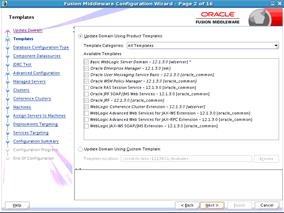
There are so many, but let’s talk about some of them and provide some examples and references. For instance, we will always have the good old config wizard: Read the complete article here.

SOA & BPM Partner Community

For regular information on Oracle SOA Suite become a member in the SOA & BPM Partner Community for registration please visit www.oracle.com/goto/emea/soa (OPN account required) If you need support with your account please contact the Oracle Partner Business Center.

Blog Twitter LinkedIn image[7][2][2][2] Facebook clip_image002[8][4][2][2][2] Wiki

Oracle publishes official Chef and Puppet samples on github by Mark Nelson and Edwin Biemond

clip_image002


Oracle official sample Chef cookbooks and Puppet modules are now available on Oracle’s official GitHub page at https://github.com/oracle/chef-samples and https://github.com/oracle/puppet-samples for Java, WebLogic and Fusion Middleware.

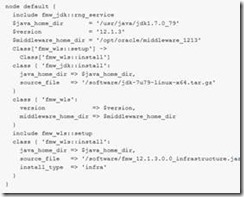
Chef and Puppet are arguably the most popular provisioning frameworks and we would like to help you with your WebLogic and Fusion Middleware provisioning by publishing samples for Chef and Puppet.  The Chef and Puppet sample modules and cookbooks are almost the same and are using the same development frameworks.

We start this series of posts with an introduction what these cookbooks and modules can do and provide a simple quickstart how to create a WebLogic domain in Chef or Puppet on a Windows, Linux or Solaris host. In the following posts we will install FMW software, patch and extend a domain with FMW software.

These Chef cookbooks and Puppet modules allow you install WebLogic together with Fusion Middleware on any Linux, Solaris or Windows host. The cookbooks should work in Chef 11 & 12 and can be used with Chef server or with Chef Solo. The modules should work on Puppet 3 & 4 and it should not matter if you use Puppet Enterprise, an agent or just use puppet apply.

The first release on github will contain the following cookbooks and modules:

  • fmw_jdk, installs JDK 7 or 8 and optionally configures the urandom random number generator service for Linux distributions.
  • fmw_wls, installs WebLogic 11g or 12c and optionally create thes Oracle user and group on solaris and linux.
  • fmw_bsu, patches a WebLogic 11g middleware home.
  • fmw_opatch, patches WebLogic 12c or any Fusion Middleware 11g, 12c product.
  • fmw_inst, installs FMW 11g, 12c product including Oracle SOA Suite, Service Bus, MFT, OIM, ADF Runtime, and WebCenter.
  • fmw_rcu, creates a 11g, 12c Common or SOA Suite FMW repository on an Oracle Database.
  • fmw_domain, creates a domain in development mode, configures the node manager, start the admin server and extend the domain with ADF/JRF, Service Bus, SOA Suite and optionally with BAM and Enterprise Scheduler.

A couple of important notes about these cookbooks and modules:

  • They don’t download any (free or licensed) software from OTN, Oracle support or edelivery, this is the responsibility of the user/customer.
  • Oracle Support won’t support these cookbooks or modules but you can raise issues or send us pull requests on github.
  • Binaries should be locally accessible in a directory or a network share.
  • They will create a domain only in development mode.
  • They won’t do multi-node provisioning like pack/unpack of a domain on cluster nodes.
  • Passwords in Chef can be defined in databags and in Puppet you need to do it yourself in Hiera.
  • They have dependencies to each other and will automatically include or require the depended manifest or recipe.
  • The default recipe/manifest does not do anything, you have to use the specific recipes or manifests. In Puppet the default manifest will be used to set some module defaults.

Detailed overview

These cookbooks and modules contains recipes and manifests with resource/providers in Chef and type/providers for Puppet. The recipes and manifest are a quick way to get you started and these minimal recipes are just calling the matching resource/type providers. You can call these yourself in one of your own cookbooks. Read the complete article here.

SOA & BPM Partner Community

For regular information on Oracle SOA Suite become a member in the SOA & BPM Partner Community for registration please visit www.oracle.com/goto/emea/soa (OPN account required) If you need support with your account please contact the Oracle Partner Business Center.

Blog Twitter LinkedIn image[7][2][2][2] Facebook clip_image002[8][4][2][2][2] Wiki

XA Transactions with SOASuite JMS Adapter by Martien van den Akker

clip_image001


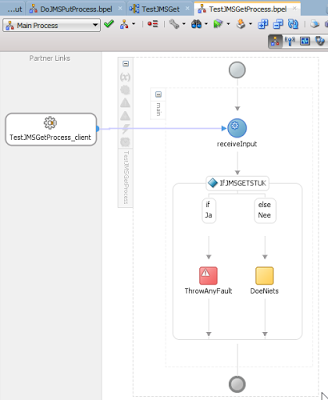
JMS is perfect for setting transaction boundaries and in OSB it is pretty clear on how JMS transactions are handled. However, in SOASuite using the JMS adapter the SOA Infrastructure is handling your JMS transactions by default; and messages are removed from the queue rightaway because the Get’s are Auto-acknowledged. If something fails, you would expect that messages are rolled back to the JMS queue and eventually moved to the error queue. But, again by default, not with the SOASuite/JMS Adapter. In that case the BPEL process, for instance, fails and get’s in a recovery state, to be handled in the ‘Error Hospital’in Enterprise Manager. But I want JMS to handle it! (Says the little boy…)
So how do we accomplish that? Today I got the chance to figure that out.
Start with a JMS setup with a JMS Server, Module and a Queue with an Error Queue that is configured to be the error destination on the first queue. On the first queue set a redelivery limit to 3 and a redelivery delay on for instance 60000 ms (or something like that). I’m not going in to that here.
Create also a Connection Factory in the JMS Module with a proper jndi, something like ‘jms/myApplicationCF’.
In the JMS adapter on SOASuite there are several OutboundConnectionFactories already pre-configured. It is quite convenient to use the one with JNDI ‘eis/wls/Queue’. But if you look into that, you’ll see that it uses the default WebLogic JMS Connection factory ‘weblogic.jms.XAConnectionFactory’. Not much wrong with that, but you can’t configure that for your own particular situation. But more over it is configured with ‘AcknowledgeMode’ = ‘AUTO_ACKNOWLEDGE’. As you can read in the docs there are three values for the AcknowledgeMode:

  • DUPS_OK_ACKNOWLEDGE, for consumers that are not concerned about duplicate messages
  • AUTO_ACKNOWLEDGE, in which the session automatically acknowledges the receipt of a message
  • CLIENT_ACKNOWLEDGE, in which the client acknowledges the message by calling the message’s acknowledge method

So create a new outbound connection factory, with a JNDI like ‘eis/jms/MyApp’. 
Now, apparently we don’t want  ‘AUTO_ACKNOWLEDGE’, because that would cause the message-get acknowledged ‘On Get’. So you could rollback until ‘Saint Juttemis’ (as we say in our family) but it won’t go back on the queue. Dups aren’t ok with me, so I’ll choose ‘CLIENT_ACKNOWLEDGE’ here. Then there’s another option: ‘IsTransacted’. I want that one on ‘true’. Then in ConnectionFactoryLocation, you’d put the JNDI of your JMS Connection factory, in my example ‘jms/myApplicationCF’. So you’ll get something like: Read the complete article here.

SOA & BPM Partner Community

For regular information on Oracle SOA Suite become a member in the SOA & BPM Partner Community for registration please visit www.oracle.com/goto/emea/soa (OPN account required) If you need support with your account please contact the Oracle Partner Business Center.

Blog Twitter LinkedIn image[7][2][2][2] Facebook clip_image002[8][4][2][2][2] Wiki

SOA & BPM Partner Community Webcast – January 31st 2017 Oracle B2B and evolution to API Driven B2B

image

Attend our January edition of the SOA & BPM Partner Community Webcast live on January 31st 2017 at 16:00 CET.

Oracle B2B and evolution to API Driven B2B

This session will present an overview of Oracle B2B platform and show a demo of the current functionality. Oracle B2B is a highly available, high-performing B2B platform that is being used by major customers across different verticals such as retail, supply chain, and utilities. Hear from Product Management about the product overview, architecture, and best practices. Also hear about how B2B integration is evolving into an API driven B2B and hear about Oracle’s vision and roadimage map.

Krishnaprem Bhatia
Twitter: KrishnapremB

Krishnaprem Bhatia is product manager in the Cloud Integration product management team focusing on B2B, Healthcare and API Management products. He has over 15 years of work experience in software development and product management. As a product manager at Oracle he has worked extensively with customers and partners worldwide in all industry verticals. He holds Computer Science & Engineering and MBA degrees and loves to read, travel and work out.

Call ID: 6965489 Call Passcode: 333111

UK: +44 (0) 208 118 1001 & United States: 140 877 440 73

More Local Numbers

Schedule:

January 31st 2017 at 16:00-17:00 CET

Visit the registration page here.


Missed our SOA & BPM Partner Community Webcast? – watch the on-demand versions:

· SOA 12 & BPM Suite 12c Roadmap update November 29th 2016

· Microservices October 25th 2016

· Oracle OpenWorld 2016 update September 27th 2016

· API Cloud Platform Service August 30th 2016

· BPM Suite & PCS Update July 26th 2016

· Integration Cloud Service June 28th 2016

· Sales Plays Webcast June 9th 2016

· Real-Time Integration Business Insight May 31st 2016

For the latest information please visit Community Updates Wiki page (SOA Community membership required).

SOA & BPM Partner Community

For regular information on Oracle SOA Suite become a member in the SOA & BPM Partner Community for registration please visit www.oracle.com/goto/emea/soa (OPN account required) If you need support with your account please contact the Oracle Partner Business Center.

Blog Twitter LinkedIn image[7][2][2][2] Facebook clip_image002[8][4][2][2][2] Wiki

Technorati Tags: SOA Community,Oracle SOA,Oracle BPM,OPN,Jürgen Kress,webcast

Oracle PaaS & Middleware Partner Community Forum March 2017

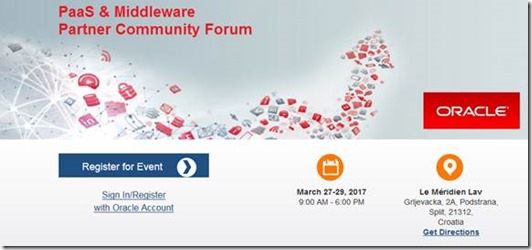
Take this opportunity and register now for the Oracle PaaS Partner Community Forum that will be held in Split, Croatia on March 27th & 28th & 29th 2017 with hands-on training on March 30th & 31st 2017. Registration is free of charge, during the conference you will get the latest updates on the Oracle PaaS Services & Middleware Solutions:

  • Process Cloud Service & BPM Suite & BPM Suite 12c
  • SOA Cloud Service & Integration Cloud Service & SOA Suite 12c
  • Mobile Cloud Service & Application Builder Cloud Service & Mobile & Development tools
  • Java Cloud & Application Container Service & Developer Cloud Service & WebLogic 12c
  • Content Cloud Service & User Experience and Enrich SaaS with PaaS
  • Internet of Things Cloud Service

The conference will update you on the last Middleware solutions & cloud services especially for:

  • Architects & Practice Managers: product overview
  • Consultants & Developers: product details including live demos and hands-on training
  • Sales Experts & Partner Managers positioning & sales kits including cheat sheets
  • Marketing Executives: campaign kits including event material and ppts and demos

For details please visit the registration page.

clip_image001

For more information watch the short video:

SOA & BPM Partner Community

For regular information on Oracle SOA Suite become a member in the SOA & BPM Partner Community for registration please visit www.oracle.com/goto/emea/soa (OPN account required) If you need support with your account please contact the Oracle Partner Business Center.

Blog Twitter LinkedIn image[7][2][2][2] Facebook clip_image002[8][4][2][2][2] Wiki

Flex fields Mapping Tool by BPM SOA Solutions Team

clip_image002


How many times have you had to repeat the same sequence in the BPM workspace to map a Human Task payload attribute to a public Flex Field? Let’s do a bit of re-cap:

  1. login to the Workspace with administration permissions
  2. go do Administration
  3. go to Public Flex Fields
  4. create all Labels

And then, for each human task:

  1. search for the task
  2. choose the payload attribute
  3. search for the label to use (you can create them here as well)
  4. repeat until you’ve mapped all the labels you need
  5. save and move to the next

It seems like a lot of work to do and it is fair to say that our platform team was not very happy to do these tasks manually. Even when developing these mappings need to be re-created from time to time (more often than we wished). The whole process is furthermore error-prone, specially when moving from development to QA and to Production environments.

Automating the creation and mapping of labels and payload atributes

Oracle BPM/SOA 11g and 12c expose an API for managing labels and mapping them as required. The oracle.bpel.services.workflow.runtimeconfig.IRuntimeConfigService interface provides a series of methods for creating and deleting labels, as well as creating oracle.bpel.services.workflow.runtimeconfig.model.PayloadMapping instances to map a label to a payload attribute. Read the complete article here.

SOA & BPM Partner Community

For regular information on Oracle SOA Suite become a member in the SOA & BPM Partner Community for registration please visit www.oracle.com/goto/emea/soa (OPN account required) If you need support with your account please contact the Oracle Partner Business Center.

Blog Twitter LinkedIn image[7][2][2][2] Facebook clip_image002[8][4][2][2][2] Wiki