Advisor Webcast: SOA and SOACS Upgrade Best Practices and Roadmap December 6th 2016

image


Register Now! Advisor Webcast SOA and SOACS Upgrade Best Practices and Roadmap December 6, 2016

This one-hour Advisor Webcast is recommended for system administrators who are interested on best practices to upgrade to SOA 12c or move to SOA Cloud Services (SOACS) .  Presented by SOA Product Management.

Schedule:

  • Tuesday , December 06, 2016 11:00 AM (US Pacific Time)
  • Tuesday , December 06, 2016 02:00 PM (US Eastern Time)
  • Tuesday , December 06, 2016 08:00 PM (Central European Time)
  • Wednesday, December 07, 2016 12:30 AM (India Standard Time)

Topics Include:

  • In-Place SOA Upgrades
  • Side by Side SOA Upgrade
  • Options Benefits Comparison
  • OnPrem SOA to SOA Cloud (SOACS) Upgrade

Duration: 1 hr Current Schedule and Archived Downloads can be found in <<Note 740966.1>>

WebEx Conference Details Topic: SOA and SOACS Upgrade Best Practices and Roadmap
Event Number: 590 560 413
Event Passcode: 909090

Register Here!

SOA & BPM Partner Community

For regular information on Oracle SOA Suite become a member in the SOA & BPM Partner Community for registration please visit www.oracle.com/goto/emea/soa (OPN account required) If you need support with your account please contact the Oracle Partner Business Center.

Blog Twitter LinkedIn image[7][2][2][2] Facebook clip_image002[8][4][2][2][2] Wiki

Asynchronous interaction in Oracle BPEL and BPM. WS-Addressing and Correlation sets by Maarten Smeets

clip_image002


There are different ways to achieve asynchronous interaction in Oracle SOA Suite. In this blog article, I’ll explain some differences between WS-Addressing and using correlation sets (in BPEL but also mostly valid for BPM). I’ll cover topics like how to put the Service Bus between calls, possible integration patterns and technical challenges.

I will also shortly describe recovery options. You can of course depend on the fault management framework. This framework however does not catch for example a BPEL Assign activity gone wrong or a failed transformation. Developer defined error handling can sometimes leave holes if not thoroughly checked. If a process which should have performed a callback, terminates because of unexpected reasons, you might be able to manually perform recovery actions to achieve the same result as when the process was successful. This usually implies manually executing a callback to a calling service. Depending on your choice of implementation for asynchronous interaction, this callback can be easy or hard.

WS-Addressing

The below part describes a WS-Addressing implementation based on BPEL templates. There are alternatives possible (requiring more manual work) such as using the OWSM WS-Addressing policy and explicitly defining a callback port. This has slightly different characteristics (benefits, drawbacks) which can be abstracted from the below description. BPM has similar characteristics but also slightly different templates.

When creating a BPEL process, you get several choices for templates to base a new process on. The Synchronous BPEL template creates a port which contains a reply (output message) in the WSDL. When you want to reply, you can use the ‘Reply’ activity in your BPEL process. The activity is present when opening your BPEL process after generation by the template, but you can use it in other locations, such as for example in exception handlers to reply with a SOAP fault. If you want to call a synchronous service, you only need a single ‘Invoke’ activity.

The output message is not created in the WSDL when using the One Way or Asynchronous templates. Also when sending an asynchronous ‘reply’, you have to use the Invoke activity in your BPEL process instead of the ‘Reply’ activity. One Way BPEL process and Asynchronous BPEL process templates are quite similar. The Asynchronous template creates a callback port and message. The ‘Invoke’ activity to actually do the asynchronous callback is already present in the BPEL process after it has been generated based on the template. The One Way template does not create a callback port in the WSDL and callback invoke in the BPEL process. If you want to call an Asynchronous service and want to do something with an asynchronous callback, you should first use an ‘Invoke’ activity to call the service and then wait with a ‘Receive’ activity for the callback. Read the complete article here.

SOA & BPM Partner Community

For regular information on Oracle SOA Suite become a member in the SOA & BPM Partner Community for registration please visit www.oracle.com/goto/emea/soa (OPN account required) If you need support with your account please contact the Oracle Partner Business Center.

Blog Twitter LinkedIn image[7][2][2][2] Facebook clip_image002[8][4][2][2][2] Wiki

Managed File Transfer for SOA Customers: Overview, Demo, Q&A with Product Mgmt, Engineering and Partners – November 15th, 2016

imageRegister Now! (all registrants will receive a link after the session to the presentation, session recording and Q&A)

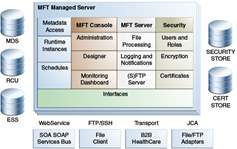
This session provides a basic product introduction to Oracle MFT from the product management team, along with real-world implementation experience and advice from an experienced SOA partner doing a cloud MFT implementation. Nearly all SOA Suite customers have needs for moving files around using managed file transfer approaches and now that Oracle has a SOA Suite component offering this functionality, we want to answer the typical questions SOA customers have around MFT, such as: what does it do and how does it work? When should I use MFT vs the SOA Suite file capabilities? What are other SOA customers doing with Oracle MFT today? Etc.

Participants in this session include:

  • Dave Berry from the Oracle Service and Cloud Integration prod mgmt team, responsible for the MFT product, providing a product overview, release timeline and demo
  • Ben Kothari of Ampliflex, talking about lessons learned and best practices from implementing MFT in the cloud for a SOA Suite 12c transportation services customer, including integrating with MFT to HR systems (e.g. Fusion HCM, Taleo, payroll, benefit providers)
  • David Shaffer of Middleworks, moderating and providing additional resources

Register Now!

SOA & BPM Partner Community

For regular information on Oracle SOA Suite become a member in the SOA & BPM Partner Community for registration please visit www.oracle.com/goto/emea/soa (OPN account required) If you need support with your account please contact the Oracle Partner Business Center.

Blog Twitter LinkedIn image[7][2][2][2] Facebook clip_image002[8][4][2][2][2] Wiki

Podcast Show Notes: Author Roundtable: SOA Suite 12c Administration by Bob Rhubart

clip_image001


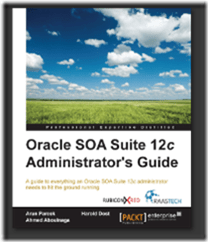
What is the role of the SOA Suite Administrator? What are the key responsibilities and challenges? These and other questions are addressed in the latest OTN ArchBeat Podcast in a wide-ranging discussion with the authors of the Oracle SOA Suite 12c Administrator’s Guide (2015, Packt Publishing).

Listen to the podcast.

The Panelists

clip_image002

Arun Pareek, Principal Consultant, Rubicon Red

clip_image003clip_image004clip_image005

clip_image006

Ahmed Aboulnaga, Oracle ACE, Technical Director, Raastech Inc.

clip_image003[1]clip_image004[1]clip_image005[1]clip_image007

clip_image009

Harold Dost, Oracle ACE Associate, Principal Consultant, Raastech Inc.

clip_image003[2]clip_image004[2]clip_image005[2]clip_image010

Additional Resources

  • Oracle SOA Suite 12c: Startup and Shutdown
    This 18-page sample chapter from the Oracle SOA Suite 12c Administrator’s Guide focuses exclusively on the startup and shutdown of the Oracle SOA Suite infrastructure and how to verify the completion of each component.
  • Community Discussion: Oracle SOA Suite
    Have a technical question about SOA Suite? Have insight to share? The Oracle SOA Suite community space includes nearly 20,000 discussions about all aspects of SOA Suite. Jump in!

SOA & BPM Partner Community

For regular information on Oracle SOA Suite become a member in the SOA & BPM Partner Community for registration please visit www.oracle.com/goto/emea/soa (OPN account required) If you need support with your account please contact the Oracle Partner Business Center.

Blog Twitter LinkedIn image[7][2][2][2] Facebook clip_image002[8][4][2][2][2] Wiki

BAM 12c Security Concept by Carsten Wiesbaum

clip_image002


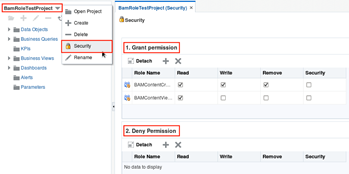
Oracle’s BI application Oracle Business Activity Monitoring (BAM) is the choice to provide Oracle Fusion Middleware (FMW) users with business insights of all running processes and applications. Due to the fact that in a standard Oracle FMW infrastructure multiple applications are hosted on which different user groups are operating one can imagine that not all information should be accessible by all users. At this point user roles and permissions become an important topic within enterprise applications. This article will provide an overview of Oracle BAM Security Concept which can be used to restrict user access to different data and dashboard categories.

Introduction to Oracle BAM Security Concept

BAM is a standard Java EE application. Therefore the same role and access right concepts apply to BAM as to any other Java EE application. When BAM is installed five standard BAM user groups are created in WebLogic standard security realm.

Each group grants a specific set of functionality to its members. The minimum requirement for a user in order to login to BAM is provided by BAMUsers group. All additional groups add more BAM functions for its users:

  • BAMContentViewer – Members can view dashboards in a project
  • BAMContentCreator – Members can create dashboards and other BAM artifacts in a project
  • BAMArchitect – Members can create new BAM Data Objects and Enterprise Message Sources
  • BAMAdministrator – Members can view and modify all resources in any project

Users can be added to user groups accord ing to the required access rights.

Adding additional BAM users

In order to add a new user to BAM one has to add the user to BAMUsers group. Afterwards the user can login. However he is not able to see any projects or access dashboards. Read the complete article here.

SOA & BPM Partner Community

For regular information on Oracle SOA Suite become a member in the SOA & BPM Partner Community for registration please visit www.oracle.com/goto/emea/soa (OPN account required) If you need support with your account please contact the Oracle Partner Business Center.

Blog Twitter LinkedIn image[7][2][2][2] Facebook clip_image002[8][4][2][2][2] Wiki

Performance by using patterns in service implementations by Maarten Smeets

clip_image001


Performance in service oriented environments is often an issue. This is usually caused by a combination of infrastructure, configuration and service efficiency. In this blog article I provide several suggestions to improve performance by using patterns in service implementations. The patterns are described globally since implementations can differ across specific use cases. Also I provide some suggestions on things to consider when implementing such a pattern. They are technology independent however the technology does of course play a role in the implementation options you have. This blog article was inspired by a session at AMIS by Lucas Jellema and additionally flavored by personal experience.
Patterns

Asynchronous services

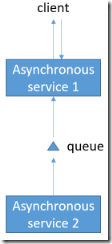
Suppose a synchronous call is made and the system takes a while to process the information. In the mean time the end-user might be waiting for the processing to be completed while the end-user might not (immediately) be interested in the response. Why not make the process asynchronous?

Making a process asynchronous has some drawbacks. The result of the processing of the request will not be available immediately in the front- and back-end so you cannot use this information yet and often you do not know when (and if) the information will become available. If something goes wrong during processing, who will be informed to take measures? (How) does the back-end inform the front-end when it’s done? You can think of server push mechanisms.

Claim-check

This is of course a famous pattern. The claim-check pattern is often used when large objects are used such as large binary files, which you do not want to pull through your entire middleware layer. Often the data is labelled and saved somewhere. The middleware can get a reference to the data. This reference can be send to the place it needs to be and the data can be fetched and processed there.

Set processing

Service calls are expensive since they often traverse several layers of hard- and software. For example I need to fetch data on a lot of persons and I have a service to fetch me person information. I can call this service for every individual person. This can mean a Service Bus instance, a SOA composite instance, a SOA component instance,a database adapter instance, a database connection and fetching of a single item all the way back (not even talking about hard- and software load-balancers). Every instance and connection (e.g. HTTP, database) takes some time. If you can minimize the instances and connections, you obviously can gain a lot of performance. How to do this is more easy than it might seem. Just fetch more than one person in a single request. Read the complete article here.

SOA & BPM Partner Community

For regular information on Oracle SOA Suite become a member in the SOA & BPM Partner Community for registration please visit www.oracle.com/goto/emea/soa (OPN account required) If you need support with your account please contact the Oracle Partner Business Center.

Blog Twitter LinkedIn image[7][2][2][2] Facebook clip_image002[8][4][2][2][2] Wiki

VirtualBox with SOA 12cR2 and StreameXplorer in 33 minutes by Peter van Nes

clip_image002


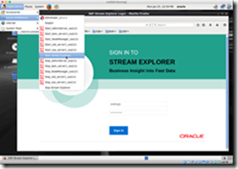
In a previous article, VirtualBox with SOA, BPM, OSB and BAM in 33 minutes, i described how you could quickly create a new Oracle VirtualBox image from scratch with SOA 12cR1. When following the instructions in this article you get almost the same result, only differences are that you will have SOA 12cR2 installed with Oracle StreameXplorer.

Because the preparation is almost the same, follow the instructions in the VirtualBox with SOA, BPM, OSB and BAM in 33 minutes, till the step “Install Oracle Linux”. Only use the Github repository reddipped/soa12cR2install instead of reddipped/soa12cR1install. Continue from there with the following steps to complete the installation.

Install Oracle Db 12c SE2

Now Linux is up and running, logon as Oracle and run the installation script for Oracle DB Standard Edition 2 from the shared folder soa12cR1install/Db12cSE2.

1

2

cd /media/sf_soa12cR2_install/Db12cSE2

./install

Install JDK 8u65

Install Java 8u65 by executing the following commands as Oracle.

1

2

3

sudo -s

rpm -ivh /media/sf_soa12cR2_install/JDK8U65/jdk-8u65-linux-x64.rpm

exit

Create the oraInst.loc

When installing oracle products silently the location of the oracle inventory location should be created. This file specifies the location of the Oracle Inventory directory where the Installer creates the inventory of Oracle products installed on the system. Just cut-and-paste the following instructions as user Oracle. Read the complete article here.

SOA & BPM Partner Community

For regular information on Oracle SOA Suite become a member in the SOA & BPM Partner Community for registration please visit www.oracle.com/goto/emea/soa (OPN account required) If you need support with your account please contact the Oracle Partner Business Center.

Blog Twitter LinkedIn image[7][2][2][2] Facebook clip_image002[8][4][2][2][2] Wiki

Oracle Fusion Middleware 12c (12.2.1.2.0) Released

clip_image001


We are proud to announce the release of Oracle Fusion Middleware 12c (12.2.1.2.0). Media is available for download on the Oracle Technology Network (OTN), My Oracle Support (MOS) and the Oracle Software Delivery Cloud (OSDC). This includes the following products:

  • Oracle SOA Suite and Business Process Management 12c (12.2.1.2.0)
    • Oracle B2B and Healthcare 12c (12.2.1.2.0)
    • Oracle Service Bus 12c (12.2.1.2.0)
    • Oracle Stream Analytics 12c (12.2.1.2.0)
    • Oracle Managed File Transfer 12c (12.2.1.2.0)
  • Oracle WebLogic Server 12c (12.2.1.2.0)
  • Oracle Coherence 12c (12.2.1.2.0)
  • Oracle TopLink 12c (12.2.1.2.0)
  • Oracle Fusion Middleware Infrastructure 12c (12.2.1.2.0)
  • Oracle HTTP Server 12c (12.2.1.2.0)
  • Oracle Traffic Director 12c (12.2.1.2.0)
  • Oracle Fusion Middleware WebLogic Server Plug-In 12c (12.2.1.2.0)
  • Oracle MapViewer 12c (12.2.1.2.0)
  • Oracle Data Integrator 12c (12.2.1.2.0)
  • Oracle Enterprise Data Quality 12c (12.2.1.2.0)
  • Oracle Enterprise Pack for Eclipse 12c (12.2.1.2.0)
  • Oracle GoldenGate Studio 12c (12.2.1.2.0)
  • Oracle GoldenGate Monitor 12c (12.2.1.2.0)
  • Oracle GoldenGate Veridata 12c (12.2.1.2.0)
  • Oracle JDeveloper Studio 12c (12.2.1.2.0)
  • Oracle Forms and Reports 12c (12.2.1.2.0)
  • Oracle WebCenter Portal 12c (12.2.1.2.0)
  • Oracle WebCenter Content 12c (12.2.1.2.0)
  • Oracle WebCenter Sites 12c (12.2.1.2.0)
  • Oracle Business Intelligence 12c (12.2.1.2.0)

Here is the related information for these releases:

You can also visit the Oracle Fusion Middleware page on OTN to find more information about the products.

Partner Resources (community membership required):

SOA & BPM Partner Community

For regular information on Oracle SOA Suite become a member in the SOA & BPM Partner Community for registration please visit www.oracle.com/goto/emea/soa (OPN account required) If you need support with your account please contact the Oracle Partner Business Center.

Blog Twitter LinkedIn image[7][2][2][2] Facebook clip_image002[8][4][2][2][2] Wiki

Patching SOA Composite Instances in Oracle 12.2.1 by Dennis

clip_image002


Introduction

Composite Instance Patching is a new feature introduced in 12.2.1 that allows compatible changes to be made to a SOA composite definition and be applied to long-running active instances. The feature enables you to patch running instances of a composite and recover faulted instances after patching the runtime. You can deliver urgent composite fixes and make compatible/allowed changes that are picked up with long-running instances without aborting them. If a patched running instance comes across a business process that has been fixed by the patch, say a BPEL transformation, then it picks up the fixes applied to the business process.

Prior to 12.2.1, there was no way to make small changes to a composite and have in-flight instances, which could be long running for days/months, or error hospital instances see those changes. The alternatives were to either redeploy an existing composite revision but that causes long running instances to stop processing, or, to create a new composite revision which does preserve existing running instances but those instances do not see the changes introduced in the new revision. Now, with the new Composite Instance Patching feature in 12.2.1, critical fixes can be applied in a timely fashion and have them take effect immediately which is a unique differentiator for Oracle SOA Suite.

In this article I will (1) highlight some of the compatible changes that can be made to a composite, (2) discuss the enhancements to JDeveloper that allow you to quickly and easily design the patch without worrying about making invalid modifications in the composite patch, and (3) outline the steps used to build, validate, and deploy the composite instance patch to the SOA runtime.

Compatible Composite Changes

As mentioned above, there are only a limited set of modifications that can be made to a composite and deemed compatible with running instances.  Some of the compatible changes that you can make include:

  • Non-schema related XSLT changes
  • Changes to fault policy, sensor data, and analytics data
  • Compatible BPEL changes such as sync/async invoke, transformation activity, assign operations, etc.
  • JCA Adapter configuration properties
  • Modifications of token values in composite references

while some of the incompatible changes that you cannot make include:

  • Deleting or renaming composite artifacts
  • Updating binding properties
  • Changes to a WSDL and Schema definition
  • Changes to XQuery mappings
  • Changes to BPEL receive inputs, structured activities, assign mapper source/target/skip conditions

Do not worry about knowing exactly what constitutes a compatible or incompatible change since, as we shall see, all those rules are accounted for in a new SOA Patch Developer mode within JDeveloper which automatically disables changes that cannot be made when constructing the patch.

Composite Instance Patch Development in JDeveloper

To simplify the creation of a composite instance patch a number of enhancements have been made to the JDeveloper tooling.  The first change is the introduction of a new new SOA Patch Developer role.  When launching JDeveloper you must first select the role that matches your requirements. Read the complete article here.

SOA & BPM Partner Community

For regular information on Oracle SOA Suite become a member in the SOA & BPM Partner Community for registration please visit www.oracle.com/goto/emea/soa (OPN account required) If you need support with your account please contact the Oracle Partner Business Center.

Blog Twitter LinkedIn image[7][2][2][2] Facebook clip_image002[8][4][2][2][2] Wiki

Testing-Concepts and Considerations in a SOA landscape that uses the Service Bus Framework by Apostolos Varsamis

clip_image002


Introduction

Due to the ever growing complexity and multiple dependencies of software components in an enterprise landscape, “Automated Testing” is no longer an optional feature of the software development process but a crucial ingredient of the development process and plays a significant role in every successfully launched software project.

Software Development in a SOA environment has its own challenges that differ from, let’s say, purely Java components. One reason is the fact that software testing needs invariant laboratory conditions; but exactly this is hard to achieve in a complex service landscape. So when designing tests it is very important to determine isolation conditions to meet these requirements. Another point worth keeping in mind is the fact that frameworks -like Oracle Fusion Middleware- follow a declarative development approach; this means that testing is possible only after the deployment and never before (because the services are de-facto built up during the deployment). Some artifacts can be tested before the deployment but we get to it later.

In this article focusing on Oracle Service Bus we outline a feasible testing strategy that allows us to implement automated testing of arbitrary complexity; starting from simple service-testing up to end-to-end tests that involve a whole service chain spread over one or more domains.

Test Categories

We assume that the reader is familiar with service classification concepts like “elementary services” or “composite services”. We also assume that the basic concepts of OSB like XQueries, Proxy and business services are well known concepts as well.

Let us focus for the moment on transformation logic. The tools offered by OSB are XQueries and XSLT transformations. These files describe, roughly speaking, how a certain XML structure should be transformed to another one, or how a piece of information can be extracted from it. Hence they can be regarded as functions that receive an XML structure as input and provide another XML structure or simple data as an output. These artifacts can be tested by java Junit means before deployment. One might consider of it as an unnecessary testing step; but it is enormous important, because it guarantees us  that no side effects would remain undetected in case e.g. a namespace or a structural modification in a XML schema has to  be carried out.

So keeping these points in mind, one can make the following distinction:

Pre-deployment Tests

These are tests mainly using Junit techniques and may be considered as “low-level” or basic tests. They should guarantee that basic transformation logic of data structures meets the requirements. Testing the XQuery components help us ensure the XQuery language correctness as well and help us avoid namespace inconsistency and confusion. Read the complete article here.

SOA & BPM Partner Community

For regular information on Oracle SOA Suite become a member in the SOA & BPM Partner Community for registration please visit www.oracle.com/goto/emea/soa (OPN account required) If you need support with your account please contact the Oracle Partner Business Center.

Blog Twitter LinkedIn image[7][2][2][2] Facebook clip_image002[8][4][2][2][2] Wiki